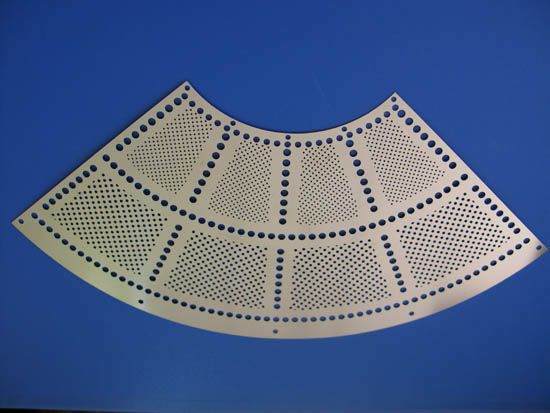
custom etch oil filter element

Precision Chemical Etching Services for Industrial

Applications Chemical etching (also known as photochemical machining) is the smart choice for producing complex, burr-free metal components with tight tolerances. At Golden Eagle, we deliver industry-leading chemical etching services for clients worldwide, combining cutting-edge technology with 20+ years of metallurgical expertise. Why Choose Our Chemical Etching Services? ✅ Material VersatilityWe work with 50+ metals including: ✅ Unmatched […]

Applications

Chemical etching (also known as photochemical machining) is the smart choice for producing complex, burr-free metal components with tight tolerances. At Golden Eagle, we deliver industry-leading chemical etching services for clients worldwide, combining cutting-edge technology with 20+ years of metallurgical expertise.

Why Choose Our Chemical Etching Services?

✅ Material Versatility
We work with 50+ metals including:

  • Stainless steel (304, 316)
  • Copper & brass alloys
  • Aluminum series
  • Nickel alloys (Inconel, Monel)
  • Titanium grades
  • Exotic metals

✅ Unmatched Precision

  • Tolerance down to ±0.01mm
  • Feature sizes from 0.1mm
  • No mechanical stress on materials
  • Consistent repeatability

✅ Industry-Specific Solutions
Our chemical etching services empower:
✈️ Aerospace: Fuel cell plates, EMI shields, sensor components
🏥 Medical: Surgical tools, implant meshes, diagnostic parts
🔌 Electronics: Lead frames, connectors, RF shields
⚙️ Automotive: Gaskets, filters, precision springs

The Chemical Etching Process

Our process ensures superior quality:

  1. Digital Tooling – CAD file conversion (DXF/DWG)
  2. Photoresist Lamination – UV-sensitive coating application
  3. Precision Exposure – UV light pattern transfer
  4. Developing Etching Stripping line – Controlled chemical dissolution
  5. Final Treatment – Cleaning, passivation, plating

No hard tooling required – ideal for prototypes and mass production

Key Advantages Over Traditional Methods

FactorChemical EtchingLaser CuttingStamping
Lead Time3-5 days5-7 days1-2 weeks
Tooling Cost$0$0$100+
Material DistortionNoneHeat-affected zoneMechanical stress
Complex GeometriesYesLimitedNo

Quality Assurance

  • 100% automated optical inspection
  • Material certs (MIL-STD, ROHS, REACH)
  • DFM analysis included
  • 24/7 production monitoring

Common Applications

  • Microfluidic plates for medical devices
  • Decorative etching for architectural metal
  • EMI/RFI shields in consumer electronics
  • Fuel cell bipolar plates
  • Membrane switches & control panels

Call to Action Section
Need Precision Metal Components?

Email : photo_etching@163.com

WeChat : +86 15010608128 

Whatsapp: +86 15010608128 

Precision chemical etching for industrial applications

See the step-by-step detail and FAQ below. >Industrial users of chemical etching are usually solving a problem that machining or stamping handles badly: very thin material, intricate internal geometry, or a part whose shape makes a hard tool expensive. Photo etching is a subtractive, photochemical process, so it costs nothing in tooling and reaches detail that would be uneconomic to machine.

Where the process wins in industry is in screens, meshes and filters. A woven or etched mesh for a filter, a screen for a gas, a shim for a heat exchanger, a gasket for a pressure vessel, or a spacer for an instrument. These parts share a characteristic: they are thin, they are made in volume, and they are specified by the drawing rather than by a standard.

The critical parameters in this work are flatness, burr-free edges and repeatability. Flatness matters because an etched part that bows will not seal; burr-free edges matter because a burr in a screen or filter changes the flow behaviour; and repeatability matters because an assembly line has to work with the part it receives, not with a nominal drawing.

We work to ISO 9001 requirements, provide material certification with each batch, and can issue dimensional inspection reports and first-article inspection reports. For customers who need visual consistency, we can also supply a first-article sample for approval before the batch is released.

Because etching is done flat, formed parts are usually etched in the blank state and formed afterwards. If you are specifying a part, it is worth telling us the end form early, because it affects how the artwork is distributed across the blank.

Frequently asked questions

What is the difference between precision etching and general etching?

Precision etching implies tighter control of dimensional accuracy, edge quality and flatness, usually with documented inspection. General etching may meet a functional requirement without the same level of measurement or traceability. For an assembly line, the difference matters less than the repeatability of the batch.

Do you work to customer drawings or produce standard parts?

Almost always to your drawing, because a photo etched part is unique to its artwork. If you have a concept rather than a drawing we can help convert it into a manufacturable artwork and give feedback on what is achievable in your chosen material and thickness.

What industries do you supply precision etching to?

Industrial equipment and instrumentation, oil and gas filtration, automotive and rail, electronics and control panels, medical and laboratory equipment, and identification and signage. We also supply architectural and decorative work in the same process.

Leave a Comment

Your email address will not be published. Required fields are marked *

Scroll to Top