
Chemical etching design guide
In chemical etching, almost every design limit scales with the sheet thickness: the thinner the metal, the smaller the holes, the narrower the webs and the tighter the tolerance. This guide gives the rules of thumb engineers use when designing photo etched parts, and how to prepare a drawing for quotation.
Rules of thumb
| Feature | Guideline (T = sheet thickness) |
|---|---|
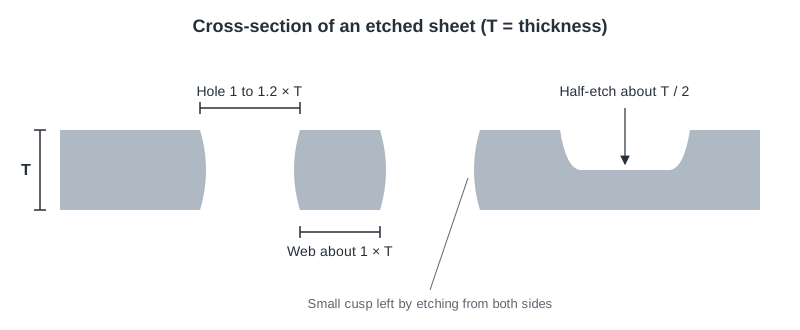
| Smallest hole diameter or slot width | About 1 to 1.2 × T |
| Smallest web or land between features | About 1 × T |
| Inside corner radius | About 1 × T |
| Outside corner radius | About 0.75 × T |
| Profile tolerance | About ±10% of T as a general rule |
| Half-etch depth | Usually around half of T |
Worked examples
Applying the rules above gives these starting points. They are guidelines, and the achievable values for your part are confirmed against the drawing.
| Sheet thickness | Smallest hole | Smallest web | Typical tolerance |
|---|---|---|---|
| 0.1 mm | 0.12 mm | 0.1 mm | ±0.01 mm |
| 0.2 mm | 0.24 mm | 0.2 mm | ±0.02 mm |
| 0.5 mm | 0.6 mm | 0.5 mm | ±0.05 mm |
| 1.0 mm | 1.2 mm | 1.0 mm | ±0.1 mm |
We etch sheet from 0.05 mm to 5.0 mm. Tolerance can be held to plus or minus 0.01 mm, depending on material thickness and part size.
Why the edge is not perfectly square
Etchant removes metal sideways as well as downwards, so it undercuts the resist slightly. Sheets are normally etched from both sides at once, which halves the undercut and leaves a small cusp at mid-thickness. If one face must have a sharp, exact edge, say so on the drawing and the part can be etched mainly from that side.
Half-etched features
Etching from one side only, to part depth, produces fold lines, flow channels, pockets, recessed text, logos and part numbers in the same run as the outline. A half-etched fold line lets a flat part be bent by hand or in a simple tool with an accurate, repeatable bend position.
Tabs
Small parts are usually held in the sheet by small tabs so they can be handled, plated and shipped as a panel. State where tabs are not allowed, for example on sealing or contact edges. Tab-free parts are possible when needed.

Preparing the drawing
- Supply vector data at 1:1 scale in DXF or DWG, with a PDF showing dimensions and tolerances.
- Draw closed outlines, and put half-etched features on a separate layer for each side.
- State the material, grade, temper and thickness.
- Mark critical dimensions, and the direction of the grain if the part will be bent.
- List any finishing: plating, passivation, forming or paint filling.
Related: metal etching service and materials, what chemical etching costs and the etching process step by step.
Request a quote
Send your drawing in DXF, DWG, STEP or PDF format with the material and grade, thickness, quantity and required delivery date through our contact page. We check manufacturability against the drawing before tooling. Sample lead time is typically 3 to 7 working days. Drawings are treated as confidential.
Chemical etching design guide: FAQ
What is the minimum hole size in chemical etching?
As a rule of thumb, the smallest hole diameter or slot width is about 1 to 1.2 times the sheet thickness. A 0.2 mm sheet can therefore carry holes of roughly 0.24 mm.
What tolerance can chemical etching hold?
A general rule is about plus or minus 10 percent of the sheet thickness, so tolerance tightens as the metal gets thinner. We can hold plus or minus 0.01 mm, depending on material thickness and part size.
What file format is needed for photo etching?
DXF or DWG vector data at 1:1 scale is preferred, together with a PDF that shows dimensions, tolerances, material and thickness. STEP files are also accepted.
What is half-etching?
Half-etching removes metal from one side only, to part of the thickness. It is used for fold lines, channels, pockets, logos and text, and is done in the same run as the through-etched outline.
What thickness of metal can be chemically etched?
We etch sheet and foil from 0.05 mm to 5.0 mm. Fine features are most practical on the thinner gauges, because minimum feature size scales with thickness.