
Chemical etching cost: what drives the price
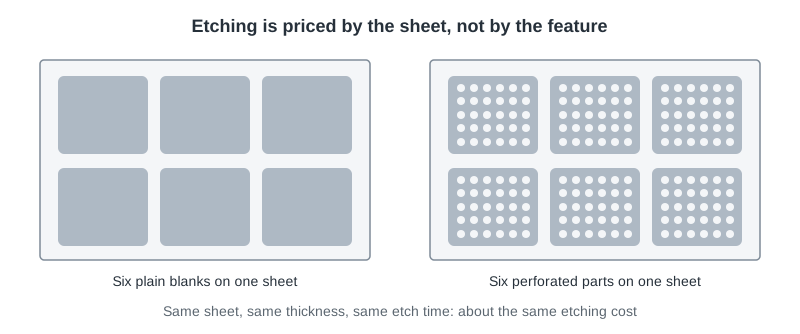
Chemical etching is priced mainly by the sheet, not by the feature. The price of a photo etched part depends on the metal, its thickness, how many parts fit on a sheet, the quantity and any finishing. The number of holes or the complexity of the outline has almost no effect, and there is no hard tooling to pay for.
The main cost drivers
| Cost driver | Effect on price |
|---|---|
| Material | Stainless steel, copper and brass are economical. Titanium and nickel alloys cost more to buy and to etch. |
| Thickness | Etch time rises with thickness, so thick parts cost more per sheet than thin parts. |
| Parts per sheet | Parts are nested on a sheet. Smaller parts and tighter nesting lower the price per part. |
| Quantity | The phototool and set-up are one-off costs, so the price per part falls as quantity rises. |
| Tolerance | Standard tolerances are the most economical. Very tight tolerances need slower processing and more inspection. |
| Finishing | Plating, passivation, forming, paint filling and special packing are added to the etching price. |
What does not add cost
- Complexity. All features are etched at the same time, so a part with a thousand holes costs about the same to etch as a plain blank of the same size.
- Half-etched logos, part numbers and fold lines. They are produced in the same run as the outline.
- Design changes. A revised design needs only a new phototool, not a new die.
Tooling cost compared with other processes
The phototool is a printed film, made from your drawing in a short time and at low cost. A stamping die is hardened steel and takes weeks to build. This is why etching is usually the lowest-cost route for prototypes and for small and medium batches, while stamping becomes cheaper per part only at very high volume. See chemical etching vs stamping and photo etching vs laser cutting.
How to lower the price
- Use the thinnest material that meets the function.
- Use a standard sheet thickness and a common grade such as 304 stainless steel.
- Keep tolerances at standard values except where the function needs more.
- Allow tabs, so parts can be supplied in panels.
- Order several designs together when they share a material and thickness; they can be nested on one sheet.
What we need to quote
We do not publish a fixed price list, because the price depends on the factors above. A quotation needs the drawing, the material and grade, the thickness, the quantity and any finishing. Design rules that keep a part economical are in the chemical etching design guide.
Request a quote
Send your drawing in DXF, DWG, STEP or PDF format with the material and grade, thickness, quantity and required delivery date through our contact page. We check manufacturability against the drawing before tooling. Sample lead time is typically 3 to 7 working days. Drawings are treated as confidential.
Chemical etching cost: FAQ
How much does chemical etching cost?
There is no single price, because etching is priced by the sheet. The cost of a part depends on the material, the thickness, how many parts fit on a sheet, the quantity, the tolerance and any finishing. Send a drawing for an exact quotation.
Is there a tooling charge for chemical etching?
Only for the phototool, which is a low-cost printed film made from the drawing. There is no hardened die, so tooling cost is a small fraction of stamping tooling.
Does a more complex part cost more to etch?
No. Every feature is etched at the same time, so extra holes, slots and fine detail do not increase etching time.
Is chemical etching cost-effective for small quantities?
Yes. Because tooling is inexpensive and quick to make, etching is well suited to prototypes and to small and medium batches.
Why does thicker metal cost more to etch?
Etching time is roughly proportional to thickness, so a thicker sheet occupies the etching line for longer and uses more etchant.