
Etched bipolar plates for fuel cells and electrolysers
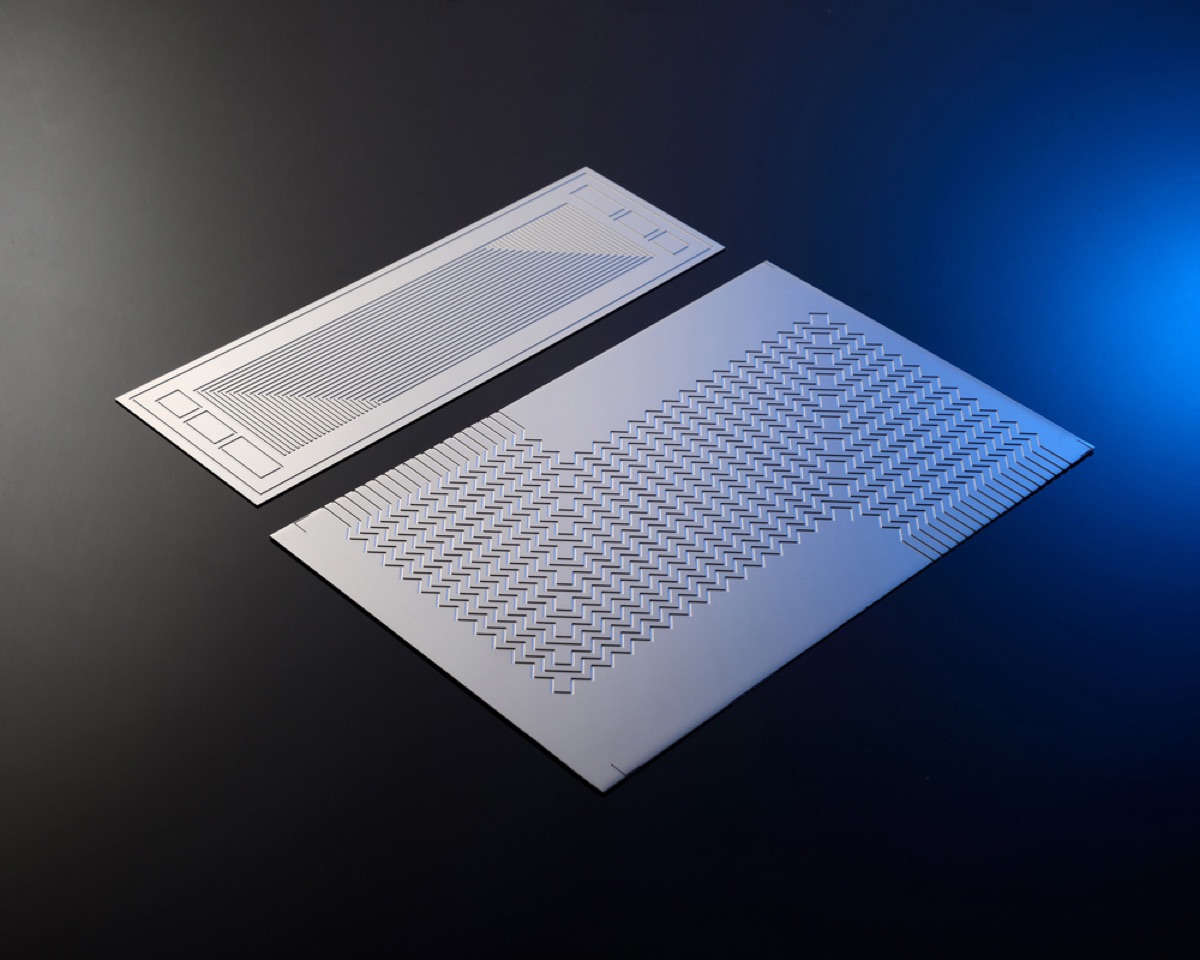
Chemical etching produces metal bipolar plates and flow field plates for fuel cells and electrolysers. Flow channels are half-etched into both faces of a thin stainless steel or titanium sheet in one operation, giving flat, burr-free and stress-free plates without hard tooling.
Why bipolar plates are etched
- Flatness. No force or heat is applied, so plates stay flat. Flatness is critical for even sealing and contact pressure across a stack.
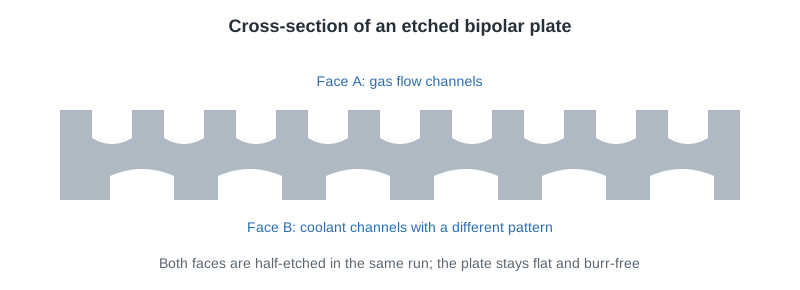
- Both faces at once. The two sides of the sheet can carry different channel patterns, for example fuel on one face and coolant on the other, etched in the same run.
- No burrs. Burr-free edges and ports protect membranes and gaskets.
- Design freedom. Serpentine, parallel, interdigitated and pin-type flow fields cost the same to etch, and channel width and depth can vary across the plate.
- Fast iteration. A revised flow field needs only a new phototool, so several designs can be tested before a design is fixed.
Etching compared with other methods
| Method | Strengths | Limits |
|---|---|---|
| Chemical etching | No tooling, flat and stress-free plates, free channel geometry, fast design changes | Etch time rises with channel depth and plate thickness |
| Stamping or hydroforming | Lowest cost per plate at very high volume | Expensive dies, springback, thinning at channel corners, slow design changes |
| CNC machining | No tooling | Slow for fine channels, burrs, stress and distortion on thin plate |
Materials
- Stainless steel, typically 316L, for fuel cell plates. See stainless steel etching.
- Titanium, typically Grade 1 or Grade 2, for electrolyser plates and corrosive conditions. See titanium etching.
Protective and conductive coatings are applied after etching by a coating specialist.
What can be etched in one run
Flow channels on both faces, manifold ports, through holes, alignment features, sealing grooves and half-etched part numbers. The same process is used for etched heat exchanger plates, which use similar channel patterns.
What we need to quote
The material and thickness, plate size, channel depth and width on each face, port positions, flatness requirement and quantity. Design limits are in the chemical etching design guide.
Request a quote
Send your drawing in DXF, DWG, STEP or PDF format with the material and grade, thickness, quantity and required delivery date through our contact page. We check manufacturability against the drawing before tooling. Sample lead time is typically 3 to 7 working days. Drawings are treated as confidential.
Etched bipolar plates: FAQ
Why are metal bipolar plates chemically etched?
Etching forms the flow channels without force or heat, so thin plates stay flat and free of burrs and stress. It needs no hard tooling, which makes it well suited to development and small to medium production.
Can both sides of a bipolar plate be etched with different patterns?
Yes. Each face has its own phototool, so different channel patterns are etched into the two sides of the sheet in the same run.
What materials are used for etched bipolar plates?
Stainless steel, typically 316L, for fuel cells, and titanium, typically Grade 1 or Grade 2, for electrolysers and corrosive conditions.
Is etching or stamping better for bipolar plates?
Etching is better for development, design iteration and small to medium volumes, because there is no die. Stamping gives the lowest cost per plate once the design is fixed and volumes are very high.