
Etched valve tags and pipe marking tags
A valve tag answers one question at the valve itself: which valve is this, what does it do, and which way should it be sitting. We etch them in stainless steel, so the number is cut into the metal rather than printed on it, and it is still readable after years of steam, lagging work and washdown.
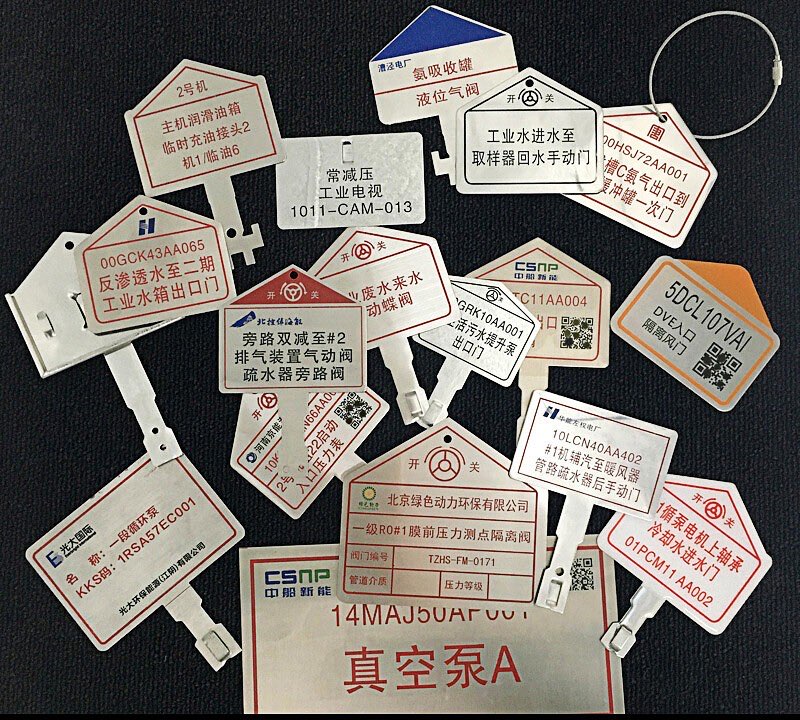
What goes on the tag
Most valve tags carry four things, and it is worth deciding each one before the artwork is made:
- The valve number. Your tag number or plant code. This is the field that has to match your drawings and your maintenance system exactly, so we set it from your list rather than retyping it.
- The service. What the valve does, in the words your operators actually use. On the tags above this is a line of text such as the feed line and the destination, not a generic category.
- State. An open or closed symbol, or a handwheel symbol with the two positions marked, so a walkdown can be done by eye.
- A code. A QR code or barcode where the tag has to link to a work order, a P&ID or an equipment record.
Open and closed: the red and green pair
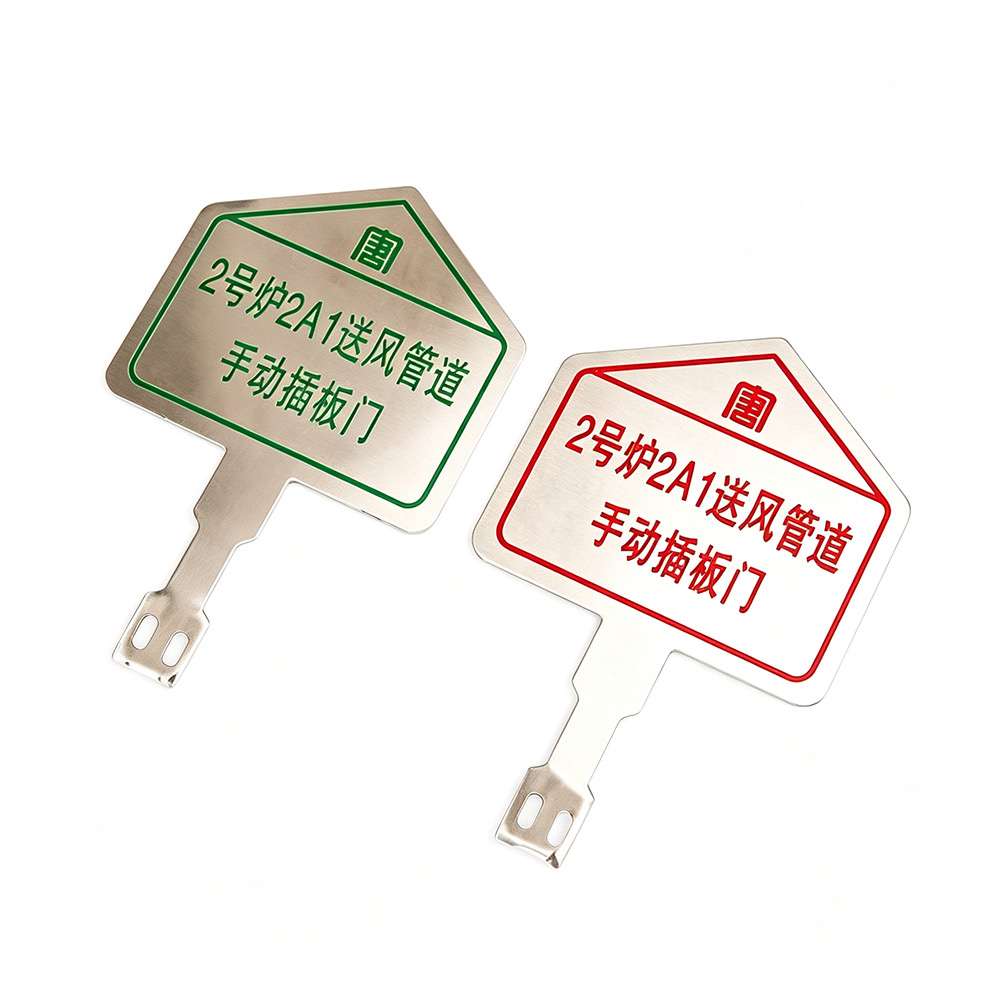
The pair above is one tag in two colours. The text, the shape and the bracket are identical; only the fill colour changes. That is the cheapest way to make the normal state of a valve readable from a distance, because the operator does not have to read anything to see it.
Colour comes from the same paint filling used on our paint filled nameplates: the pigment sits inside the etched recess, below the surface of the metal, so it does not wear off the way a printed or anodised colour does. If you want more than two states, tell us the full list and what each colour means, and we will keep one artwork file with a colour variant per state rather than separate drawings.
The stem bracket
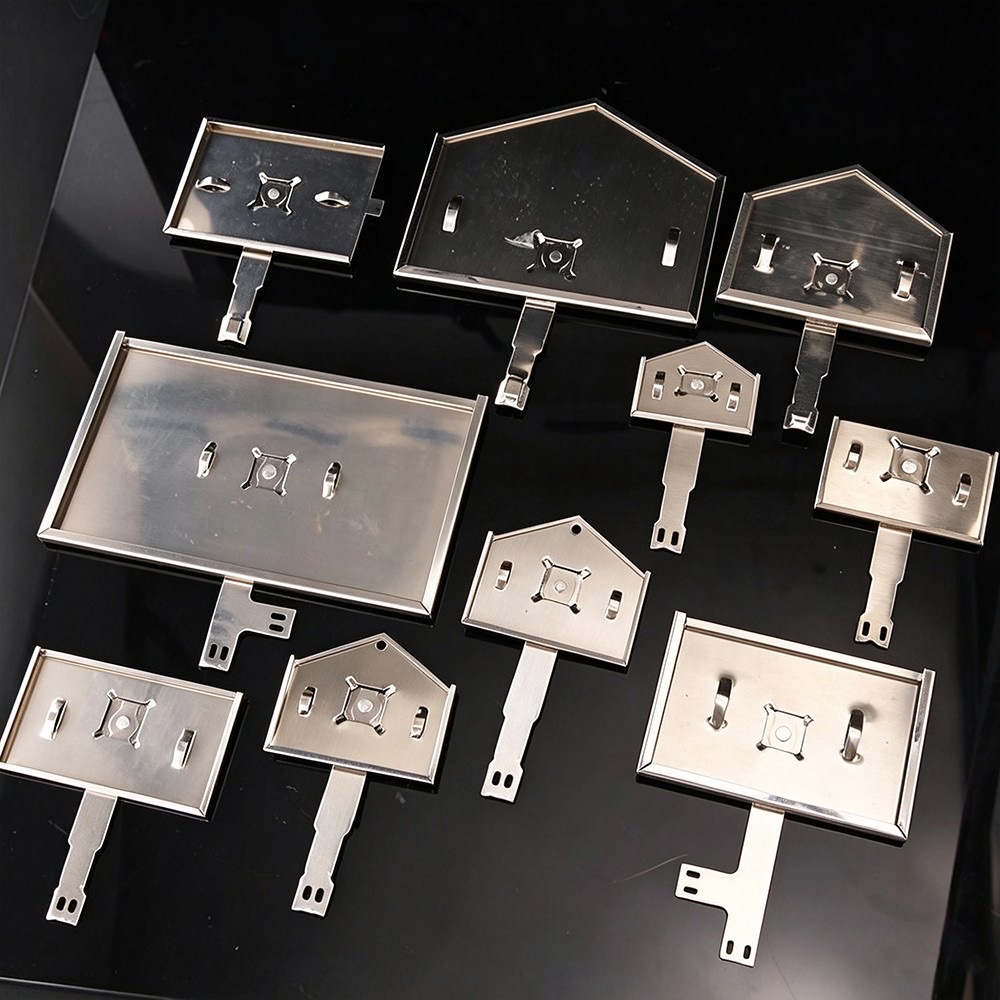
The long stem is what separates a plant valve tag from a general purpose hanging tag. It reaches past lagging and past the handwheel so the tag sits where it can be read, and the slotted holes in it let the same tag suit more than one stem diameter.
Two details are visible on the backs above. The edges are folded back, which stiffens a thin tag and takes away the cut edge, so nobody gets caught on it during a walkdown. And the fixing tabs are formed into the stem rather than added as separate hardware, so there is nothing to come loose. Where a tag has to hang instead, we etch a plain hole and supply it with a stainless wire or cable loop.
There is no standard size list to pick from. The tag outline, the stem length and the slot positions are all cut by the same etching step, so they are set per job: tell us the pipe or stem diameter, how far the tag has to clear the lagging, and how much text has to fit, and we draw the outline to suit. Changing the size between orders costs a new phototool, not a new press tool, which is why a custom outline is not a premium here.
Plant coding systems
Several of the tags above carry codes in KKS format, the power plant identification system published by VGB PowerTech as VGB-S-811-01 and related to DIN 6779 and IEC 61346. KKS codes are long, they are case sensitive, and a single wrong character makes the tag useless, which is exactly why we work from your exported list rather than from a retyped one.
The same applies to any other scheme you use, whether that is ISA tag numbers, a P&ID line number or an in-house system. Send the list as a spreadsheet with one row per tag. We do not edit, reformat or auto-correct the code column, and we send back a proof showing every tag in the run so you can check the codes against your register before anything is etched.
Materials and finish
| Material | Use it for |
|---|---|
| 304 stainless | General plant, indoor and outdoor pipework, the default |
| 316 stainless | Marine, coastal, offshore and chemical service, or where chlorides are present |
| Brass | Where a traditional look is wanted, or to match existing tags on site |
| Anodised aluminium | Lighter tags, and where a dark background gives better code contrast |
Shapes come out of the etching step rather than a press tool, so the pentagon, the rectangle, the stem and the slotted holes are all cut in the same operation and cost the same whatever the outline. That also means a shape change between orders costs a new phototool, not a new die.
Related
- Etched stainless ID plates, ID tags and asset tags for asset numbering, serialised tags and QR codes
- Machine ID plates and data plates for the plate on the equipment itself
- Paint filled nameplates for how the colour is applied
- Stainless steel etched nameplates for 304 and 316 in more detail
Request a quote
Send the tag list as a spreadsheet with one row per tag, the finished tag size, the stem length you need and the colour rule if you use one. Artwork as DXF, DWG, AI or PDF if you have a drawing; if you do not, send a photo of an existing tag and we will work from that. We return a proof of the full run before etching. Sample lead time is typically 3 to 7 working days. Your tag list is treated as confidential. Send it through our contact page.
Etched valve tags: FAQ
What material should a valve tag be?
304 stainless for general plant, 316 where chlorides are present such as marine, coastal and chemical service. Brass is used where it has to match tags already on site. All three etch and paint fill the same way.
Can valve tags show whether the valve is normally open or closed?
Yes. The usual method is a colour pair: the same tag etched in green for normally open and red for normally closed, so the state reads at a distance without anyone having to read text. A handwheel symbol with the two positions marked is also common.
Can you etch KKS codes onto the tags?
Yes, and we work from your exported list rather than retyping the codes. You get a proof of the whole run before etching so the codes can be checked against your register.
How are the tags fixed to the valve?
Either a stem bracket with slotted holes, which is etched and formed as part of the tag, or a plain hole with a stainless wire or cable loop for hanging. Tell us which when you send the list, because it changes the outline.
What sizes do valve tags come in?
There is no fixed size range. The outline, the stem length and the slot positions are etched to the job, so they are set from your pipe or stem diameter, the clearance you need past lagging, and the amount of text on the tag. A custom outline costs a phototool, not a press tool.
Is there a minimum quantity?
No hard tooling is involved, so short runs are practical. The phototool is the only setup cost and it is shared across every tag on the same sheet, which is why a mixed run of different tags costs much the same as a run of identical ones.