
Etched vs engraved vs printed nameplates
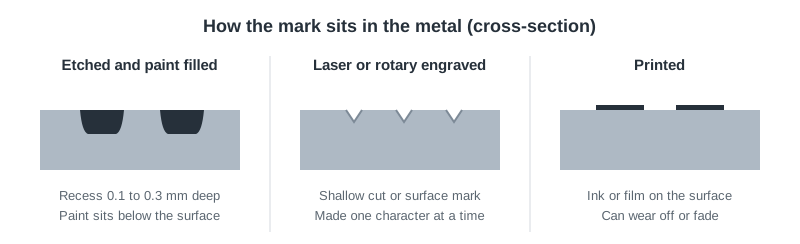
Etched nameplates have the marking chemically dissolved into the metal, engraved nameplates have it cut or burned in one character at a time, and printed nameplates have it applied on top of the surface. Etching gives the best combination of durability, fine detail and cost for batches of metal nameplates; engraving suits one-off plates and variable data; printing suits full colour indoors.
Comparison at a glance
| Factor | Chemical etching | Laser engraving | Rotary engraving | Printing | Stamping / embossing |
|---|---|---|---|---|---|
| How it marks | Dissolves metal through a mask | Burns or anneals the surface | Cuts with a rotating tool | Ink or film on the surface | Presses characters with a die |
| Durability | Very high; recessed | High; shallow | High; cut in | Lower; can wear or fade | Very high |
| Fine detail and logos | Excellent | Excellent | Limited by tool size | Excellent, full colour | Limited |
| Colour | Paint fill, PVD, anodising | Dark or light mark only | Paint fill possible | Any colour | None, or paint on raised areas |
| Cost per plate in a batch | Low; whole sheet at once | Rises with marked area | High; slow | Low | Lowest at very high volume |
| Set-up cost | Low-cost phototool | None | None | Low | High; needs a die |
| Different data on each plate | Yes | Yes, easiest | Yes | Yes | Limited |
| Best for | Batches of durable metal plates | One-offs and adding data later | Single plaques and thick plates | Colourful indoor labels | One design in very large numbers |
Etched vs laser engraved nameplates
A laser marks one plate at a time, and the time rises with the area marked. Etching processes a whole sheet of plates together, so large logos, filled backgrounds and dense tables cost no more than a line of text. Etching also gives a deeper recess, which holds paint and stays readable after repainting. Laser engraving is the better choice for a handful of plates or for adding a serial number to a finished plate.
Etched vs printed nameplates
Screen and digital printing put ink on top of the metal. They give full colour at low cost but can be scratched, dissolved by solvents or faded by sunlight. Etched and filled marking sits below the surface, protected by the metal around it. Choose printing for indoor, short-life or highly colourful labels, and etching where the plate must outlast the equipment.
Etched vs stamped or embossed nameplates
Stamping needs a hard die, which pays for itself only on very large quantities of one design, and it cannot reproduce fine logos or small text. Etching has no die, so it suits many variants and frequent changes. Blank fields on an etched plate can still be stamped with ratings later. See also chemical etching vs stamping.

Which should you choose
- Outdoor, industrial or long-life plates in any quantity above a few pieces: etched, in stainless steel or anodised aluminum.
- Coloured logos that must not wear off: etched and paint filled.
- One or two plates needed today: laser or rotary engraved.
- Full-colour indoor labels: printed.
- Hundreds of thousands of one simple plate: stamped.
For the general difference between the two processes see chemical etching vs engraving, and for the full range see custom etched metal nameplates.
Request a quote
Send the artwork or drawing (AI, PDF, DXF or DWG) with the material, thickness, size, quantity, finish, colours and mounting method through our contact page. For serialised plates, send the number range or a data file. We return a proof for approval before production. Sample lead time is typically 3 to 7 working days. Artwork and drawings are treated as confidential.
More on etched nameplates
Etched vs engraved vs printed nameplates: FAQ
What is the difference between etched and engraved nameplates?
Etched nameplates are marked by chemically dissolving the metal through a mask, a whole sheet at a time. Engraved nameplates are marked by a laser or cutting tool, one character at a time. Etching is more economical for batches and large marked areas; engraving suits one-off plates.
Are etched nameplates more durable than printed ones?
Yes. Etched marking is recessed into the metal and protected by the surrounding surface, while printed marking is a surface layer that can be scratched, dissolved or faded.
Is chemical etching cheaper than laser engraving for nameplates?
For batches, usually yes. Etching cost depends on sheet area, not on how much of the plate is marked, while laser time rises with the marked area. For one or two plates laser engraving is cheaper because there is no phototool.
Can etched nameplates have a different serial number on each plate?
Yes. Serial numbers, barcodes and QR codes can be etched individually. Plates can also be supplied with blank fields for later stamping or laser marking.