
Photo etching vs laser cutting
Photo etching dissolves metal chemically through a photographic mask, so every feature on the sheet is produced at the same time with no heat. Laser cutting melts the metal along a programmed path, one feature after another. For thin sheet with many holes or fine detail, etching is usually cleaner and cheaper; for thick plate and simple outlines, laser cutting is usually faster.
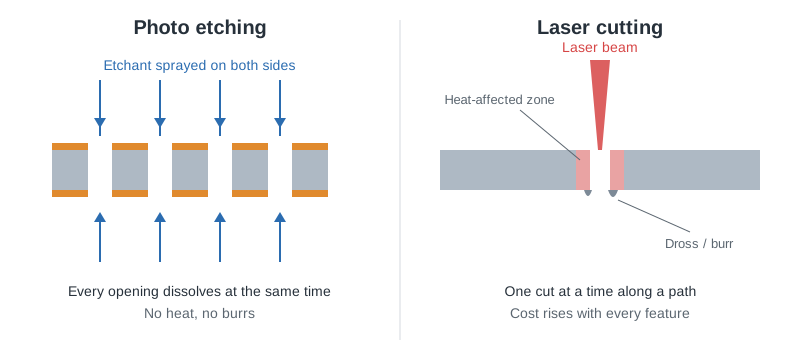
Comparison at a glance
| Factor | Photo etching | Laser cutting |
|---|---|---|
| How metal is removed | Chemical dissolution through a resist mask | Melting and vaporising along a cut path |
| Heat | None, so no heat-affected zone | Local heating; thin sheet can discolour or distort |
| Edge condition | Burr-free | Dross or micro-burrs are common and may need cleaning |
| Effect of complexity on cost | None; all holes and slots etch at once | Cost rises with every extra cut and pierce |
| Tooling | Low-cost phototool | No tooling, only a program |
| Partial-depth features | Half-etched channels, fold lines, logos and text in the same run | Marking only; controlled-depth pockets are not practical |
| Best thickness | Foil and sheet from 0.05 mm to 5.0 mm, strongest on thin gauges | Thin to thick plate; strongest on thicker material |
| Reflective metals | Copper, brass and aluminium etch readily | Reflective metals are harder to cut cleanly |
| Best suited to | Meshes, filters, shims, contacts, shields, intricate flat parts | Simple profiles, thicker parts, one-off blanks |
Where photo etching is the better choice
- Dense patterns. A filter mesh with thousands of holes costs the same to etch as a blank of the same size, because the etchant acts on the whole sheet at once. A laser must pierce and cut each hole in turn.
- Thin, flat parts. With no heat or force, parts stay flat and keep their temper and magnetic properties.
- Features at partial depth. Fold lines, flow channels, recessed text and part numbers are etched together with the outline.
- Clean edges. No dross, recast layer or burr, which matters for contacts, shims and parts that slide or seal.

Where laser cutting is the better choice
- Thick plate. Etch time grows with thickness, while a laser cuts thick plate quickly.
- Simple outlines in small numbers. A single simple blank with no fine detail is quick to program and cut.
- Vertical edges on thick parts. An etched edge has a slight profile from etching both sides; a laser cut edge is closer to square.
How to choose
Choose photo etching when the part is thin, flat and detailed, when burrs or heat are unacceptable, or when the design includes half-etched features. Choose laser cutting when the part is thick and the outline is simple. For high-volume production of a stable design, compare both with stamping in chemical etching vs stamping.
Related: chemical etching design guide and what chemical etching costs.
Request a quote
Send your drawing in DXF, DWG, STEP or PDF format with the material and grade, thickness, quantity and required delivery date through our contact page. We check manufacturability against the drawing before tooling. Sample lead time is typically 3 to 7 working days. Drawings are treated as confidential.
Photo etching vs laser cutting: FAQ
Is photo etching more accurate than laser cutting?
On thin sheet, yes in most cases. Etching applies no heat, so there is no distortion or heat-affected zone, and fine features such as small holes and narrow webs are reproduced from a high-resolution phototool. On thick plate, laser cutting gives a squarer edge.
Is photo etching cheaper than laser cutting?
It depends on complexity and quantity. Etching cost is driven by sheet area and thickness, not by the number of features, so complex parts and larger batches favour etching. A single simple part is often cheaper to laser cut.
Does photo etching leave burrs?
No. The metal is dissolved rather than cut or melted, so there are no burrs, dross or recast layer.
Can a laser make half-etched features?
A laser can mark a surface, but it cannot economically produce controlled-depth channels or fold lines across a part. Photo etching produces them in the same run as the outline.