
Etched encoder discs and code wheels
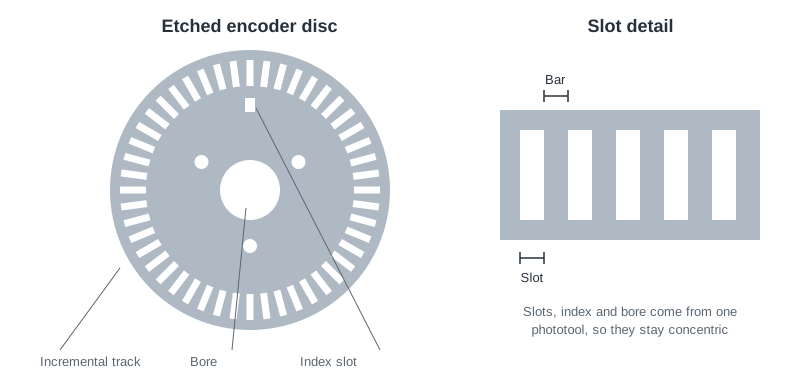
Metal encoder discs are thin slotted wheels that interrupt a light beam so a sensor can count position and speed. Photo etching is the standard way to make them: every slot is produced at the same time from one high-resolution phototool, so slot spacing is uniform, edges are burr-free and the disc stays flat. We etch encoder discs, code wheels and linear strips to customer drawings.

Why encoder discs are photo etched
- Uniform slots. Slot positions come from the phototool, not from a punch indexing around the disc, so pitch error does not build up.
- Clean optical edges. No burrs or dross to scatter light or catch dust.
- Flat, stress-free discs. No punching force, so thin discs do not warp and run true.
- Concentric features. Bore, mounting holes, index slot and tracks are all on the same phototool.
- Fast design changes. A different line count needs a new phototool only.
Materials and thickness
| Material | Typical thickness | Notes |
|---|---|---|
| Stainless steel 304 / 301 | 0.05 to 0.3 mm | Most common; stiff, corrosion resistant, non-magnetic grades available |
| Nickel silver | 0.1 to 0.3 mm | Etches cleanly with fine detail |
| Brass and copper alloys | 0.1 to 0.3 mm | Easy to etch; can be blackened or plated |
Design limits
- Minimum slot width is about 1 to 1.2 times the material thickness, so thinner material allows a higher line count.
- Minimum bar between slots is about the material thickness.
- Tolerance can be held to ±0.01 mm, depending on material thickness and part size.
- Discs can be supplied loose or held in the sheet by small tabs placed away from the optical track.
Types we make
Incremental discs with one or two tracks and an index slot, absolute and Gray-code discs, linear encoder strips, tachometer and timing wheels, optical chopper wheels and slotted apertures.
What to send for a quote
A DXF or DWG drawing with the line count, slot dimensions, bore and outside diameter, plus the material, thickness and quantity. See the design guide and photo etching vs laser cutting.
Request a quote
Send your drawing in DXF, DWG, STEP or PDF format with the material and grade, thickness, quantity and required delivery date through our contact page. We check manufacturability against the drawing before tooling. Sample lead time is typically 3 to 7 working days. Drawings are treated as confidential.
Etched encoder discs: FAQ
What is the best material for a metal encoder disc?
Stainless steel between 0.05 mm and 0.3 mm thick is the most common choice because it is stiff, stable and corrosion resistant. Nickel silver and brass are also used where a finer pattern or a particular surface finish is needed.
How fine can the slots of an etched encoder disc be?
Minimum slot width is about 1 to 1.2 times the material thickness. A 0.1 mm thick disc can therefore carry slots of roughly 0.1 to 0.12 mm.
Why is etching better than laser cutting for encoder discs?
Etching produces every slot at once without heat, so the disc stays flat, the edges are free of dross and the cost does not rise with the number of slots. A laser cuts each slot in turn and heats the thin metal.
Can you make linear encoder strips as well as discs?
Yes. Linear encoder strips and scales with slot patterns are etched in the same way, within the size of the sheet.