
Spring steel chemical etching
Chemical etching cuts flat springs, clips and flexures from spring steel that is already hardened and tempered. Because the metal is dissolved rather than sheared or melted, the part keeps the hardness and spring force of the strip it was made from, with no burrs and no heat-affected edge. We etch carbon and stainless spring steel from 0.05 mm thick.
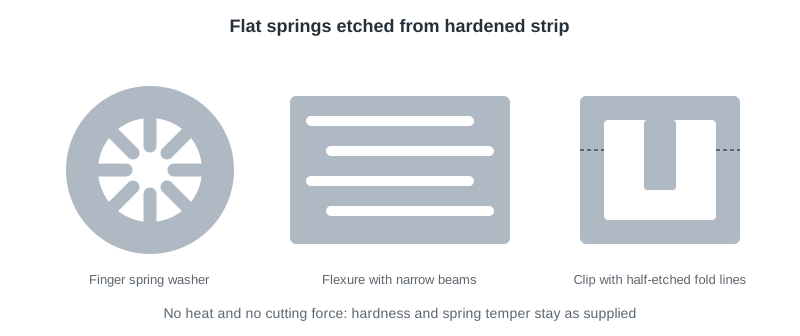
Why spring steel is etched rather than stamped or laser cut
- Temper is unchanged. Stamping work-hardens the cut edge and a laser softens it. Etching does neither, so the spring rate is predictable from the strip data.
- No burrs or micro-cracks. A burr or a nick on the edge of a spring is where fatigue cracks start. Etched edges are smooth and free of them.
- Hard strip is not a problem. Fully hardened strip wears punches and dies quickly. Hardness makes no difference to an etchant.
- Low-cost design changes. Beam width or length can be adjusted on a new phototool to tune spring force, without a new die.
Grades we etch
| Type | Common grades | Notes |
|---|---|---|
| Carbon spring steel | SK5, C75S (1075), C100S (1095), 65Mn | Supplied hardened and tempered or annealed. Needs oiling or plating after etching to prevent rust. |
| Stainless spring steel | 301 in 1/2 hard, 3/4 hard and full hard; 304 hard | Corrosion resistant; the usual choice for clips, contacts and spring washers. |
| Precipitation hardening stainless | 17-7PH | Etched in the soft condition or after heat treatment, as the drawing requires. |
Capabilities
- Thickness: 0.05 mm to 5.0 mm; most springs are between 0.05 mm and 1.0 mm.
- Tolerance can be held to ±0.01 mm, depending on material thickness and part size.
- Minimum beam or slot width: about 1 to 1.2 times the material thickness.
- Half-etched fold lines, part numbers and thinned sections in the same run.

Typical parts
Flat springs, spring clips, finger and wave washers before forming, flexures, diaphragms, retaining rings, battery and EMI contacts, shims and reed-type parts.
Design notes
Give inside corners a radius at least equal to the material thickness to lower stress. State the rolling direction on the drawing if the spring bends across a narrow beam. For forming after etching, a half-etched fold line gives an accurate bend position. See the chemical etching design guide for all feature rules, and phosphor bronze etching for conductive springs.
Request a quote
Send your drawing in DXF, DWG, STEP or PDF format with the material and grade, thickness, quantity and required delivery date through our contact page. We check manufacturability against the drawing before tooling. Sample lead time is typically 3 to 7 working days. Drawings are treated as confidential.
Spring steel etching: FAQ
Does chemical etching change the hardness of spring steel?
No. Etching applies no heat and no mechanical force, so hardened and tempered strip keeps its hardness and spring properties. There is no heat-affected zone and no work-hardened edge.
Can hardened spring steel be etched?
Yes. The etchant dissolves hardened and annealed steel in the same way, so fully hardened strip can be etched directly and no heat treatment is needed afterwards.
How thin can spring steel be etched?
We etch spring steel from 0.05 mm thick. Most flat springs and clips are made from strip between 0.05 mm and 1.0 mm.
Will carbon spring steel rust after etching?
Bare carbon steel will rust if left unprotected. Parts are cleaned and dried after etching and then oiled, or plated or blackened if the drawing calls for it. Stainless spring steel does not need this.