
Phosphor bronze chemical etching
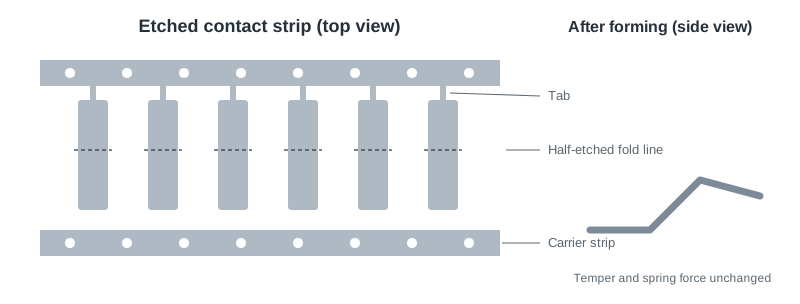
Phosphor bronze chemical etching produces thin spring contacts, terminals and connector parts without burrs or mechanical stress. Because nothing shears or heats the strip, the temper, spring force and fatigue life of the alloy are the same after etching as before.
Why phosphor bronze is etched rather than stamped
Phosphor bronze is a copper-tin alloy with a small addition of phosphorus. It is chosen for its spring properties, fatigue resistance, conductivity and corrosion resistance. Stamping work-hardens the cut edge and leaves a burr, both of which matter on a small spring finger. Chemical etching removes metal without force, so thin fingers stay flat and behave as the material data sheet predicts.
Grades
Common spring grades include C5191 and C5210 (also specified as C51000 and C52100), supplied in tempers from half hard to extra spring hard. Etching does not change the temper, so the grade and temper are chosen for the function of the part.
Typical etched parts
- Spring contacts and contact fingers
- Battery contacts and terminals
- Connector and switch parts
- Grounding clips and EMI shielding fingers
- Diaphragms, washers and shims
- Lead frames and small precision springs

Process notes
- Etchant: phosphor bronze etches cleanly in ferric chloride or cupric chloride, like other copper alloys.
- Bending: half-etched fold lines can be added to locate bends. State the rolling direction on the drawing, because spring tempers bend best across the grain.
- Plating: etched parts are commonly plated with tin, nickel, silver or gold for solderability and contact resistance.
- Thickness: we etch sheet from 0.05 mm to 5.0 mm; most contact parts use the thin end of this range.
Related materials
For other copper alloys see copper etching and brass etching. For solderable shielding parts see nickel silver etching and etched EMI and RF shielding. Design limits are in the chemical etching design guide.
Request a quote
Send your drawing in DXF, DWG, STEP or PDF format with the material and grade, thickness, quantity and required delivery date through our contact page. We check manufacturability against the drawing before tooling. Sample lead time is typically 3 to 7 working days. Drawings are treated as confidential.
Phosphor bronze chemical etching: FAQ
Can phosphor bronze be chemically etched?
Yes. Phosphor bronze etches cleanly in ferric chloride or cupric chloride, in the same way as copper and brass.
Does etching change the spring properties of phosphor bronze?
No. Chemical etching applies no force or heat, so the temper, spring force and fatigue resistance are unchanged. This is the main reason it is preferred for thin spring contacts.
Which phosphor bronze grades are commonly etched?
C5191 and C5210, also specified as C51000 and C52100, in tempers from half hard to extra spring hard.
Can etched phosphor bronze parts be plated?
Yes. Tin, nickel, silver and gold plating are common, for solderability and low contact resistance.