
Aerospace chemical etching and chemical milling
Two things make chemical processes useful in aerospace work. Etching cuts thin, complex parts without applying force or heat, so shims, screens and brackets come out flat, burr-free and free of residual stress. Chemical milling removes metal only where the drawing allows it, which is how weight is taken out of a panel without weakening the ribs that carry the load.

Chemical milling for weight reduction
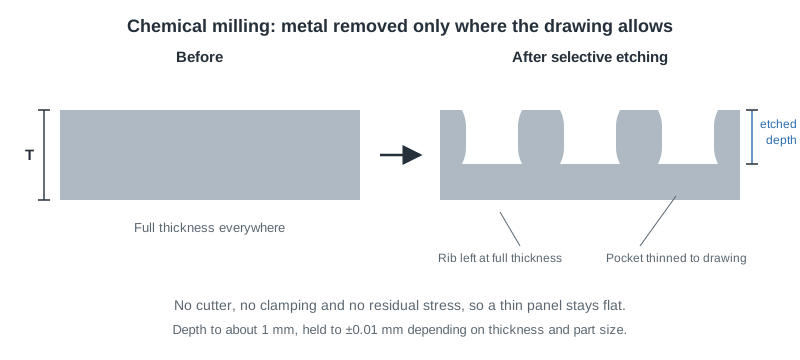
Chemical milling (also called chemical machining) masks the areas that must stay thick and dissolves the rest to a controlled depth. There is no cutter, no clamping force and no heat, so a large thin panel does not distort and no residual stress is introduced for a later heat treatment to relieve.
What we etch for aerospace work
| Part | Why it is etched |
|---|---|
| Shims and spacers | Burr-free from 0.05 mm, so a stack measures its true height |
| Filter screens and meshes | Thousands of openings in one pass, with no loose particles at the edges |
| Weight-reduced panels and skins | Chemical milling to about 1 mm deep, with no distortion |
| Flat springs, clips and retainers | Hard temper strip keeps its spring rate, because etching is cold |
| Shielding and EMI parts | Etched flat with fold lines, then formed |
| Gaskets and sealing washers | Clean edges, no burr to interfere with the seal |
| Identification and data plates | Marking etched into the metal, so it survives fluids and abrasion |
Materials and limits
- Materials: titanium (including Grade 1, 2 and Ti-6Al-4V), stainless steel, nickel alloys, copper alloys, aluminium and steel.
- Thickness: 0.05 mm to 5.0 mm.
- Maximum sheet: 1500 × 3000 mm, so long skins and large screens are etched in one piece.
- Tolerance: Tolerance can be held to ±0.01 mm, depending on material thickness and part size.
- Minimum hole or slot: about 1 to 1.2 times the material thickness.
- Chemical milling depth: to about 1 mm.
Where these parts are used
We are a Beijing etching works, established 2003. The aerospace work we see most often is ground support equipment, test rigs and tooling, cabin and interior parts, filter screens, shims and identification plates. Tell us what documentation you need with the parts at the enquiry stage and we will confirm what we can provide before you order.
Related: titanium etching, etched shims, spring steel etching and the design guide.
Request a quote
Send the drawing in DXF, DWG, STEP or PDF format with the material and grade, the thickness, the quantity and any documentation you need with the parts. We check the feature sizes against the drawing before tooling and tell you what to change if anything falls below the limits above. Sample lead time is typically 3 to 7 working days. Drawings are treated as confidential. Send yours through our contact page.
Aerospace chemical etching: FAQ
What is the difference between chemical etching and chemical milling?
Chemical etching cuts right through the sheet to produce a part. Chemical milling removes metal only to a controlled depth, leaving the part in one piece but thinner in the masked areas. Aerospace uses the second to take weight out of panels. We mill to about 1 mm deep.
Can titanium be chemically etched?
Yes. Titanium protects itself with an oxide film, so it needs hydrofluoric-acid-based chemistry rather than the ferric chloride used for stainless steel. We etch commercially pure Grade 1 and Grade 2 and Ti-6Al-4V from 0.05 mm.
Can you etch Inconel and other nickel alloys?
Yes. Nickel alloys need different chemistry from stainless steel and they etch more slowly, which is why fewer suppliers quote them. Send the alloy and thickness with the drawing and we will confirm the feature sizes we can hold on that material.
How large a panel can you chemically mill?
Up to 1500 × 3000 mm in one piece. Parts larger than that have to be split and joined.