
Nickel silver chemical etching
Nickel silver is a copper-nickel-zinc alloy with a silver-white colour. It contains no silver. It etches cleanly, solders without plating and resists tarnish, which makes it a standard material for photo etched EMI shielding cans, scale model detail parts, nameplates and decorative parts.
Why nickel silver is chosen
- Solderable as etched. It can be soldered directly, without tin plating.
- Corrosion resistant. It tarnishes far more slowly than brass or copper.
- Stiffer than brass. Thin parts hold their shape, and fine detail is less easily damaged.
- Silver-white appearance. It polishes well and can be used unplated for decorative parts.
Common grades
C7521 and C7701 (also specified as C75200 and C77000) are the grades most often supplied as thin sheet for etching. They are sometimes called German silver or alpaca.
Typical etched parts
| Application | Examples |
|---|---|
| Electronics | EMI and RF shielding cans, frames and covers, contacts, grounding clips |
| Scale models | Detail parts for model railways, ships, aircraft and vehicles: grilles, ladders, railings, frames |
| Identification | Nameplates, dials, scales and labels |
| Decorative | Jewellery components, bookmarks, ornaments, inlays |
| Instruments | Small parts for musical and measuring instruments |
Process notes
- Etchant: ferric chloride, as for brass and copper.
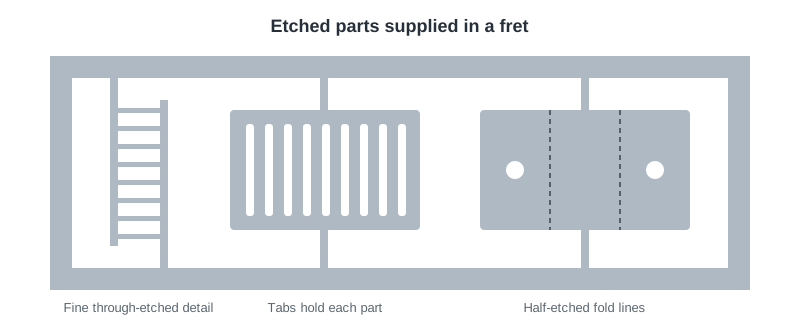
- Half-etching: fold lines, rivet detail, panel lines and recessed text are etched in the same run as the outline, which is why the alloy is popular for model parts and shielding cans.
- Tabs: small parts are supplied held in a fret by tabs, so they can be handled and cut out as needed.
- Thickness: we etch sheet from 0.05 mm to 5.0 mm.
Related pages
Etched EMI and RF shielding, phosphor bronze etching, brass etching and the chemical etching design guide.
Request a quote
Send your drawing in DXF, DWG, STEP or PDF format with the material and grade, thickness, quantity and required delivery date through our contact page. We check manufacturability against the drawing before tooling. Sample lead time is typically 3 to 7 working days. Drawings are treated as confidential.
Nickel silver chemical etching: FAQ
Does nickel silver contain silver?
No. Nickel silver is an alloy of copper, nickel and zinc. The name refers only to its silver-white colour.
Can nickel silver be chemically etched?
Yes. It etches cleanly in ferric chloride, in the same way as brass and copper, and holds fine detail well.
Why is nickel silver used for EMI shielding cans?
It can be soldered directly without plating, it resists corrosion, and it is stiff enough for thin-walled cans.
Why is nickel silver used for etched model parts?
It is stiffer than brass, solders easily, resists tarnish and takes paint well, and half-etching reproduces fine surface detail and fold lines.