
Inconel etching and nickel superalloy etching
Inconel is specified because it keeps its strength where other alloys do not: in heat, in exhaust gas, in acid. The same property makes it awkward to machine and hard on stamping dies, because it work-hardens as the tool cuts. Photo etching never touches the metal, so a thin Inconel part comes out burr-free, with no work-hardened edge, no heat-affected zone and no residual stress.
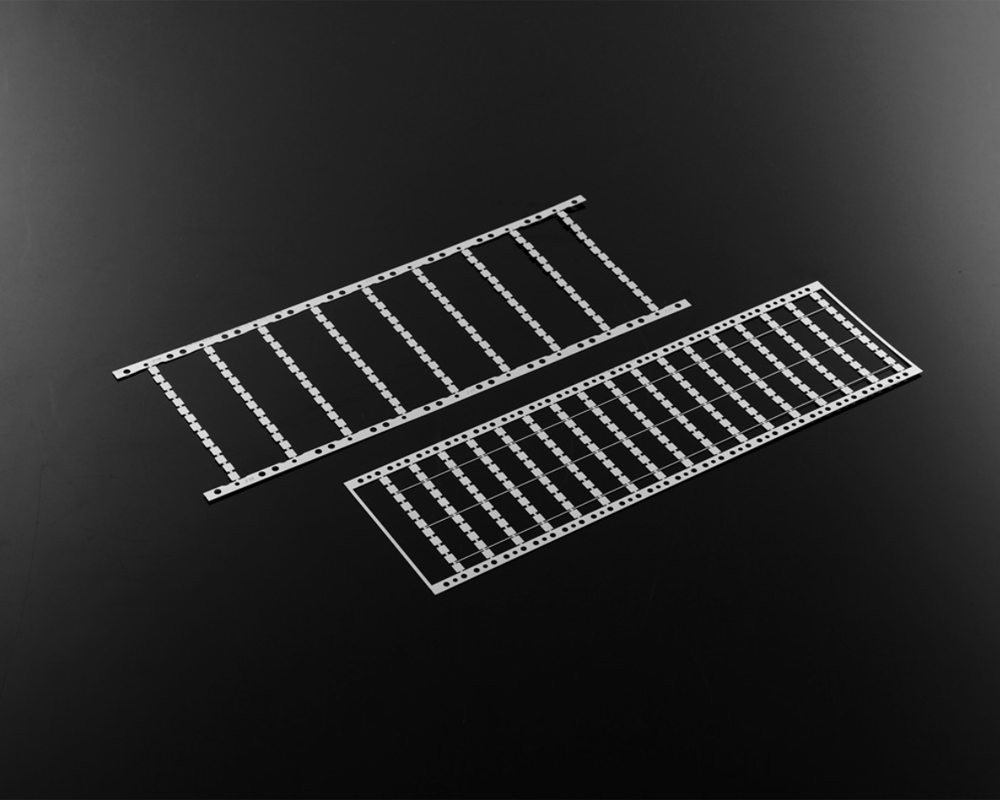
Why Inconel parts are etched rather than cut
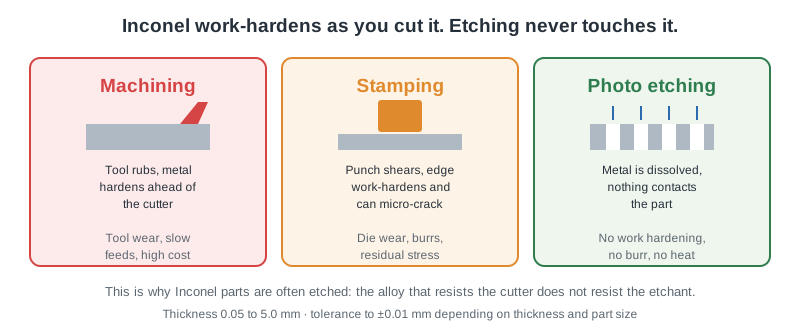
- No work hardening. Nothing contacts the part, so the edge keeps the properties of the parent sheet and the spring rate can be taken from the material data.
- No tool or die cost. Inconel wears punches and cutters quickly. A phototool costs the same whatever the alloy, so short runs and design changes stay economical.
- Complexity is free. A screen with thousands of holes etches in the same pass as a plain blank.
- No heat. No heat-affected zone, no distortion of a thin panel, and no oxide to clean off.
Alloys we etch
| Alloy | Why it is specified | Typical etched parts |
|---|---|---|
| Inconel 600 / 601 | Oxidation resistance to high temperature | Furnace screens, heating element parts, gaskets |
| Inconel 625 | Strength plus seawater and acid resistance | Marine and chemical screens, bellows parts, shims |
| Inconel 718 | Highest strength of the group, age hardenable | Springs, seals, turbine and engine hardware |
| Inconel X-750 | Spring properties at temperature | High-temperature springs and clips |
| Monel 400 | Nickel-copper, excellent in seawater | Marine screens, valve and pump parts |
| Hastelloy C-276 | Severe chemical service | Filter screens, process plant parts |
| Nickel 200 / 201 | Commercially pure nickel, conductive | Battery tabs, connectors, electrodes |
| Invar / Kovar | Low or matched thermal expansion | Lead frames, masks, optical and sensor parts |
If your drawing calls for an alloy that is not listed, send it with the enquiry. The question is always the same one: how fast that alloy etches and whether the resist holds for that long.
What changes when you etch Inconel instead of stainless
Worth knowing before you compare quotations, because it explains why fewer suppliers offer this work:
- It etches more slowly. High-nickel alloys resist the etchant as well as they resist corrosion, so the sheet spends longer in the line. That is the main reason the price per part is higher than for stainless of the same thickness.
- The resist has to last longer. A longer etch means more time for the mask to lift at the edges, so resist choice and adhesion matter more than they do on steel.
- Undercut has to be allowed for. Longer immersion means more sideways attack under the mask, so the phototool is compensated for the alloy and the thickness rather than using a single standard allowance.
- Condition matters. Solution treated, aged and cold-rolled material do not etch at the same rate. State the condition on the drawing.
Capabilities
| Item | Range |
|---|---|
| Thickness | 0.01 mm to 5.0 mm; most nickel alloy parts are 0.05 mm to 1.0 mm |
| Tolerance | Can be held to ±0.01 mm, depending on material thickness and part size |
| Minimum hole or slot | About 1 to 1.2 times the material thickness |
| Maximum sheet | 1500 × 3000 mm |
| Chemical milling | Selective thinning to about 1 mm deep, for weight reduction and flow channels |
| Half-etching | Fold lines, recesses and part numbers in the same run as the outline |
| Edge condition | Burr-free, no dross, no recast layer, no work-hardened layer |
| Delivery format | Loose parts, or held in the sheet by tabs for handling and finishing |
| Sample lead time | Typically 3 to 7 working days after the drawing is confirmed |
Typical Inconel and nickel alloy parts

- Filter screens and meshes for hot gas, fuel and aggressive chemical service.
- Heat exchanger and reformer plates with half-etched flow channels.
- Gaskets, shims and spacers that must hold dimension at temperature.
- Flat springs, clips and diaphragms in Inconel 718 and X-750.
- Sensor and probe components for exhaust and process measurement.
- Masks and apertures in Invar and Kovar where expansion must be matched.
Related
Request a quote
Send the drawing in DXF, DWG, STEP or PDF format with the alloy and condition, the thickness, the quantity and any finishing you need. Tell us if the material is solution treated, aged or cold rolled, because that changes how it etches. We check the feature sizes against the drawing before tooling. Sample lead time is typically 3 to 7 working days. Drawings are treated as confidential. Send yours through our contact page.
Inconel etching: FAQ
Can Inconel be chemically etched?
Yes. Inconel and the other high-nickel alloys are photo etched in the same way as stainless steel, but they resist the etchant more strongly, so the sheet spends longer in the line and the resist and phototool allowance are chosen for the alloy. We etch Inconel from 0.01 mm.
Why etch Inconel instead of machining or stamping it?
Inconel work-hardens as a tool cuts it, which wears cutters and punches quickly and leaves a hardened, sometimes micro-cracked edge. Etching removes metal chemically, so nothing contacts the part: no work hardening, no burr, no heat-affected zone and no tooling to wear out.
Is etching Inconel more expensive than etching stainless steel?
Per part, usually yes, because the alloy etches more slowly and occupies the line for longer. The difference is in etch time, not in tooling: the phototool costs the same whatever the alloy, so short runs stay economical.
Which Inconel grades do you etch?
The grades that come up most often are 600, 601, 625, 718 and X-750, along with related nickel alloys such as Monel 400, Hastelloy C-276, Nickel 200 and 201, and the low-expansion alloys Invar and Kovar. Send any other alloy with your enquiry.
Can you chemically mill Inconel to reduce weight?
Yes. Selective thinning to about 1 mm deep removes metal only inside masked pockets, leaving ribs at full thickness. There is no cutter and no clamping force, so a thin panel does not distort.
Does etching change the properties of Inconel?
No. The process is cold and applies no force, so hardness, temper and corrosion resistance are those of the sheet you specified. State the condition, for example solution treated or aged, on the drawing.