
Etched room number plates, door signs and level signs
These are the plates that get fitted by the hundred: a number beside every door, a level sign at every landing, a plate in every lift lobby. They are etched in stainless steel or brass, so the number is cut into the metal and survives the cleaning, knocks and repainting that a building gets for decades.
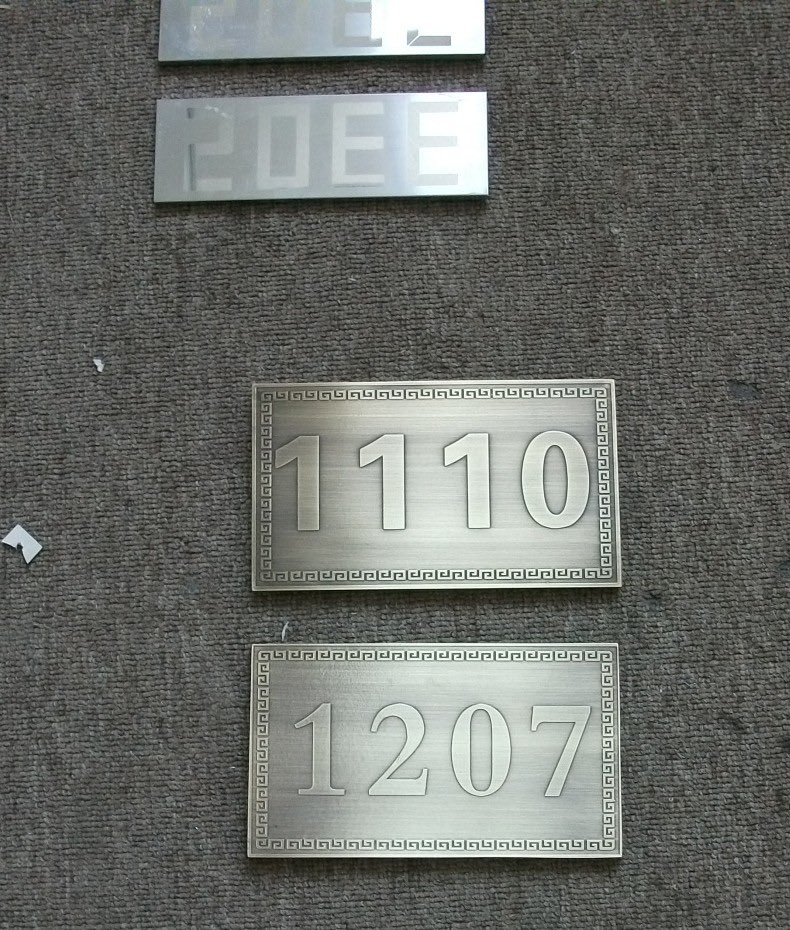
What this covers
| Plate | What it carries |
|---|---|
| Room number plate | The room or apartment number, on its own or with a name field |
| Door number sign | Number plus a function such as Store, Plant or Electrical |
| Door name plate | An occupant or department name, often in a changeable holder |
| Pictogram sign | A symbol only: toilets, lift, stairs, no smoking |
| Floor level sign | Level number at the lift lobby or in the stair core |
| Staircase level sign | Level and stair reference inside the stair shaft |
| Lift sign | Lift number, level and service or passenger designation |
| Room directional sign | Arrow and destination for corridors |
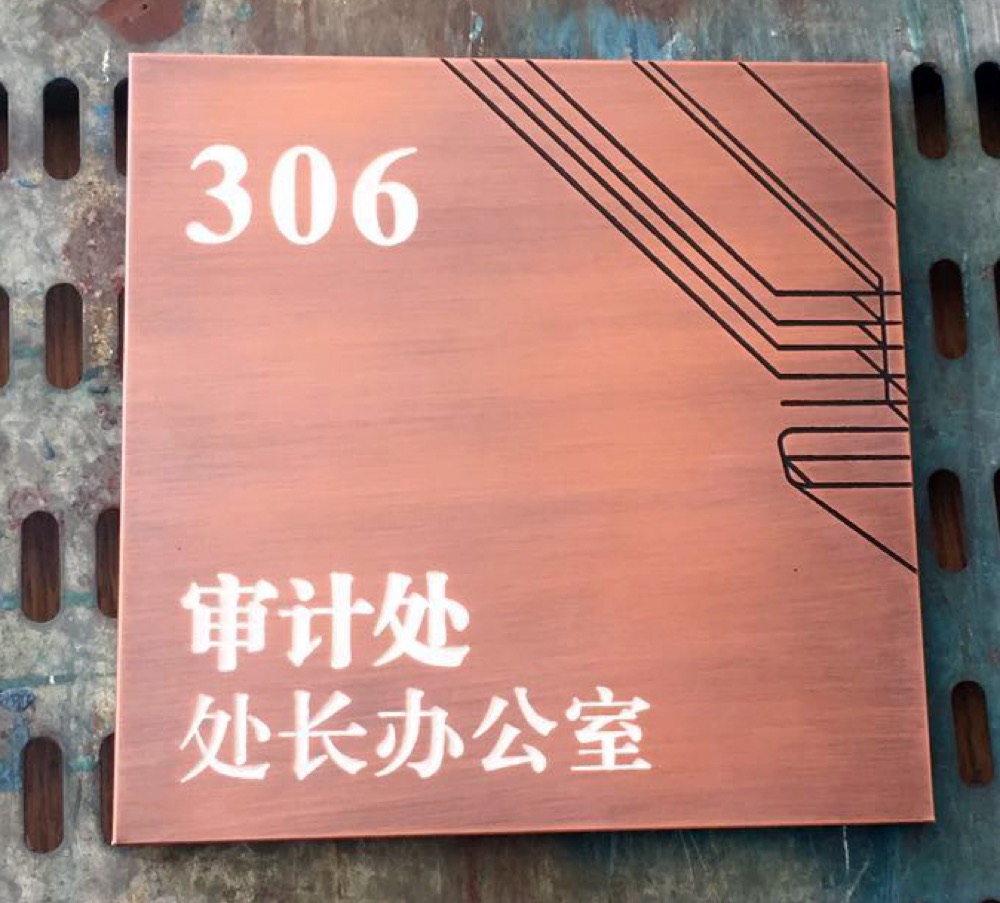
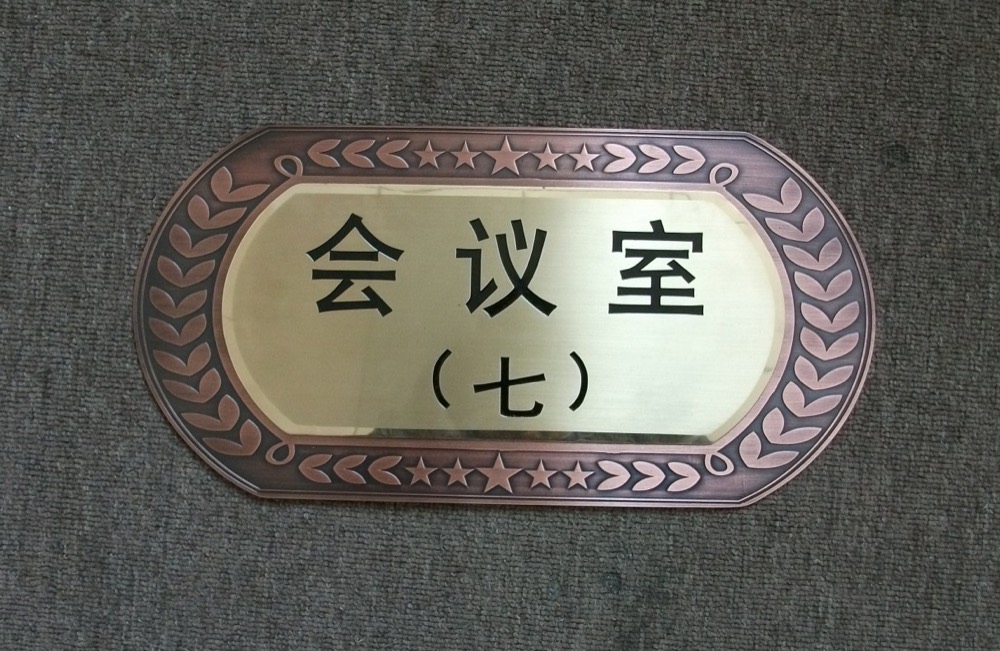
Hotels, apartment blocks, offices and hospitals order these as one package because they share a single artwork family and one numbering list. Pricing works the same way: the setup is per design, not per plate, so three hundred different numbers cost what three hundred identical plates cost.
Tactile and braille signs
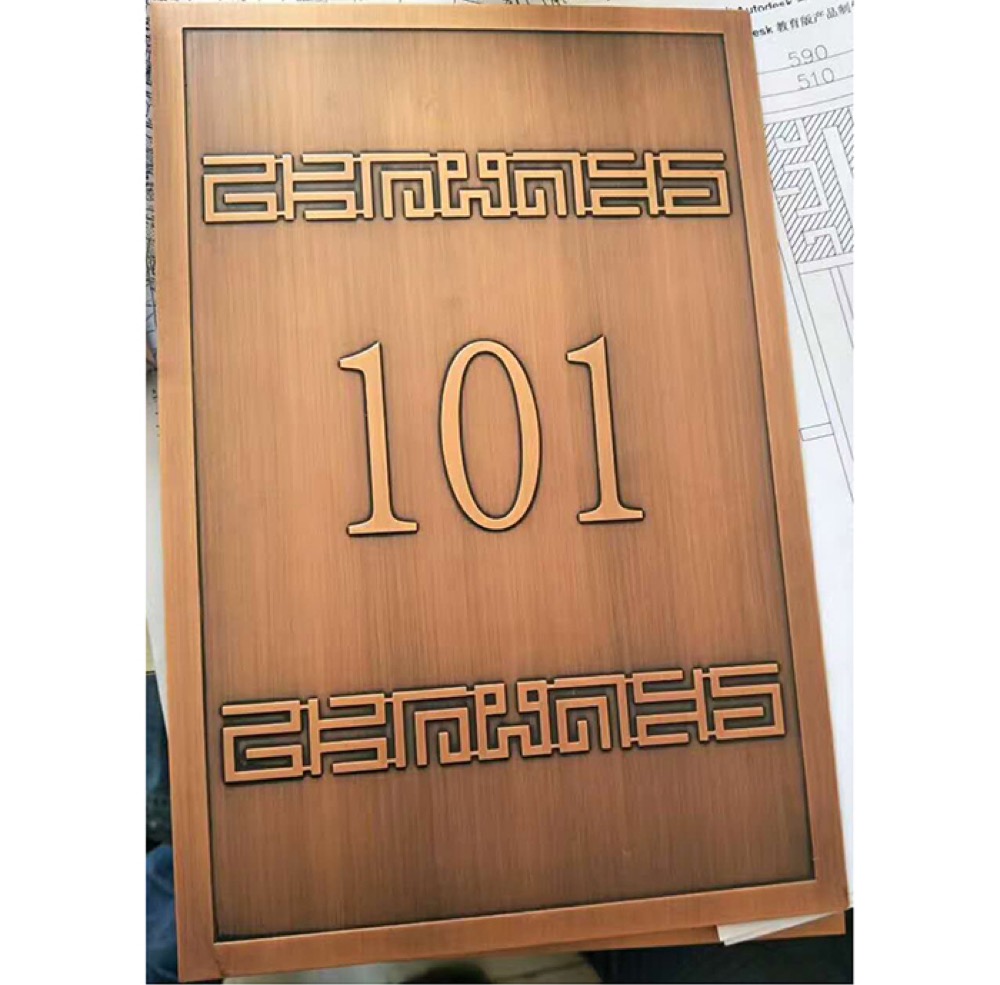
Accessible room signs need characters you can read with a finger, not just with your eyes. Etching produces those directly: we etch the background away and leave the characters standing proud of the surface, which is the same process we use for reverse-etched equipment plates. The raised height comes out of how deep the background is etched, so it is set to whatever the project standard calls for.
For reference, the ADA 2010 Standards in the United States call for raised characters at least 1/32 inch (0.8 mm) above the surface, sans serif and in upper case, between 5/8 inch and 2 inches high, with Grade 2 braille placed below the text and set back from other characters and the plate edge. Signs identifying a room are mounted on the latch side of the door, with the lowest tactile character 48 inches above the floor and the highest no more than 60 inches. Projects outside the United States work to their own standard, so tell us which one governs and we will set the plate to it rather than assuming.
Braille dots are supplied with the plate. Send the text and the standard, and say whether the braille is Grade 1 or Grade 2, because the two are not interchangeable and a contracted Grade 2 cell layout cannot be derived from a Grade 1 file.
Numbering a whole building
A building package is a serialised job: every plate carries a different number and none of them may be wrong. Send the numbering list as a spreadsheet with one row per plate and a column for each field, and we return a proof of the full run before anything is etched, so the numbers can be checked against the room schedule while they are still cheap to change.
Three things to decide before the run:
- Skipped numbers. Floors that omit 4 or 13, or rooms that were deleted after the room schedule was issued. Tell us to leave them out rather than renumbering around them.
- Phased handover. If the building opens level by level, say so, and we split the run by level so the first delivery matches the first handover rather than arriving as one pallet.
- Replacements. We keep the artwork, so a damaged plate is re-run at its original number years later and matches the rest.
The same approach is described for industrial work on our serialised tags and asset tags page.
Materials and finish
| Material | Use it for |
|---|---|
| 304 stainless, brushed | The default for interior room and door numbers |
| 316 stainless | Coastal and poolside buildings, and external door signs |
| Brass | Hotels, heritage buildings and villa entrances where a warmer tone is wanted |
| Anodised aluminium | Lighter plates and large directional panels |
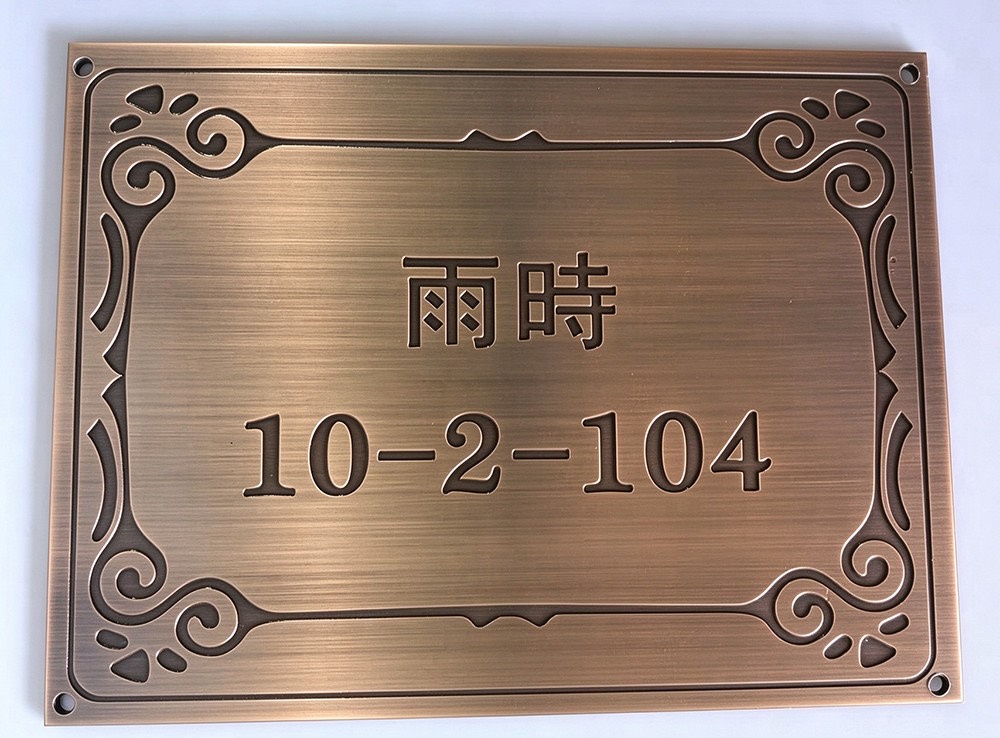
Numbers and symbols are usually paint filled for contrast, with the plate face left as bare brushed metal. The colour sits inside the etched recess, so corridor plates can be wiped daily without the numbers fading. Fixing is by adhesive on a flat painted wall, or through etched screw holes where the plate goes onto a door or a masonry wall.
Related
- Custom etched metal nameplates for the full range
- Weather-resistant etched signage for external and boundary signs
- Paint filled nameplates for colour and contrast
- Serialised tags and asset tags for numbering systems
- Etched vs engraved vs printed for the process comparison
Request a quote
Send the numbering list as a spreadsheet, the plate size, the material and finish, and the standard the signs are built to if the project has one. Artwork as AI, PDF, DXF or DWG where you have it; a photo of an existing plate is enough to work from if you do not. Say whether braille is required and whether the plates are adhesive or screw fixed. We return a proof of the full run before etching. Sample lead time is typically 3 to 7 working days. Drawings and room schedules are treated as confidential. Send them through our contact page.
Etched room number plates: FAQ
Can etched plates carry raised tactile characters?
Yes. The background is etched away so the characters stand proud of the plate face. The raised height is set by the etch depth, so it is made to the standard the project works to.
Do you supply braille on room signs?
Yes. Send the text and say whether the project needs Grade 1 or Grade 2 braille, and which standard governs, because the cell layout differs between them.
Does a run of 300 different room numbers cost more than 300 identical plates?
No. The setup cost is in the artwork and the phototool, which is shared across the sheet, so a run of unique numbers costs much the same as a run of identical plates.
What material is best for room number plates?
Brushed 304 stainless for interiors, 316 for coastal buildings and external doors, brass where a warmer finish suits the building. All three etch and paint fill the same way.
How are the plates fixed?
Adhesive backing on flat painted walls, or screw holes etched with the outline for doors and masonry. Tell us which when you order, because it changes the plate thickness and the outline.