
Plating and finishing of etched parts
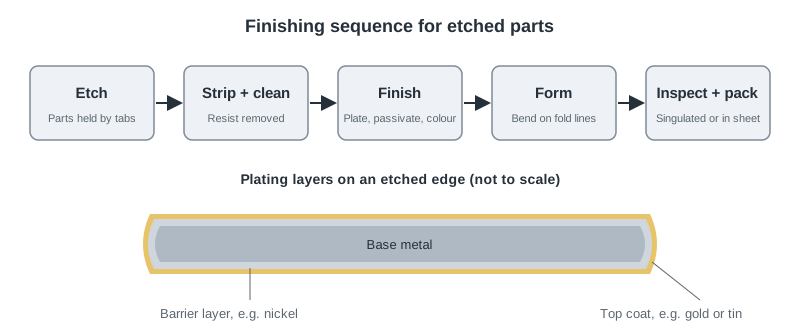
Most etched parts are finished before use: plated for solderability or conductivity, passivated for corrosion resistance, coloured for appearance or formed into shape. Etched parts are well suited to finishing because they are burr-free and can stay tabbed in the sheet, so a whole sheet of parts is plated and handled as one piece. This page lists the common finishes and when each is used.
Finishes by purpose
| Finish | Applied to | Why it is used |
|---|---|---|
| Nickel plating (electrolytic or electroless) | Copper alloys, steel | Corrosion and wear resistance; barrier layer under gold or tin |
| Tin plating | Copper alloys, nickel silver, steel | Solderability at low cost, for shields and contacts |
| Silver plating | Copper alloys | High conductivity, wire-bond areas on lead frames, RF parts |
| Gold plating | Copper alloys over nickel | Stable low contact resistance for connectors and contacts |
| Passivation | Stainless steel | Restores the passive layer and improves corrosion resistance |
| Electropolishing | Stainless steel | Smooth, bright surface for filters, medical and food-contact parts |
| Black oxide or chemical blackening | Steel, stainless steel, copper alloys | Low reflection for optical parts and encoder discs |
| PVD colour coating | Stainless steel | Gold, black, rose and other decorative colours |
| Anodising | Aluminium | Hard, coloured, corrosion-resistant surface |
| Paint filling | Nameplates, dials, scales | Coloured text and graphics in etched recesses |

Plating etched parts in the sheet
Small parts are usually left attached to the sheet or carrier strip by tabs. The sheet is plated as a single piece, which gives even coverage and avoids barrel damage to thin parts. After plating the parts are separated at the tabs, so each part has a small unplated point where the tab was. If that is not acceptable, say so on the drawing and the tab can be placed on a non-functional edge or the parts can be plated loose.
Selective finishes
Etching and finishing can be combined on selected areas: gold or silver only on contact or bond areas, colour coating etched away to show bright metal, or paint filled into half-etched recesses.
Forming and assembly
Half-etched fold lines allow accurate bending by hand or with simple tools. Formed shields, clips and brackets are bent after plating or before it, depending on the coating. See EMI and RF shielding for folded cans.
What to specify on the drawing
- Finish type and the standard or specification it must meet.
- Thickness of each layer, for example nickel 2 to 5 µm with gold 0.05 to 0.1 µm.
- Areas to be plated or kept bare.
- Whether tab marks are allowed and where.
- Whether dimensions apply before or after plating.
Tell us the finish with the enquiry so that etching, finishing and packing are quoted together. Related: phosphor bronze etching, nickel silver etching, etched lead frames and etched encoder discs.
Request a quote
Send your drawing in DXF, DWG, STEP or PDF format with the material and grade, thickness, quantity and required delivery date through our contact page. We check manufacturability against the drawing before tooling. Sample lead time is typically 3 to 7 working days. Drawings are treated as confidential.
Plating and finishing of etched parts: FAQ
Can etched parts be plated?
Yes. Etched parts are commonly plated with nickel, tin, silver or gold. They are burr-free, which gives even coating thickness on the edges, and they can be plated while still tabbed in the sheet.
Are parts plated before or after etching?
Usually after etching, so that the etched edges are covered as well as the faces. Pre-plated material can be etched, but the cut edges will then be bare base metal.
Does stainless steel need a finish after etching?
Not always. Stainless steel is corrosion resistant as etched. Passivation is added for demanding environments, electropolishing for a smooth bright surface, and PVD coating for colour.
Will plating change the dimensions of an etched part?
Slightly. Each plated layer adds its thickness to every surface, typically a few microns. State on the drawing whether dimensions apply before or after plating.