
Chemical etching prototype service
Chemical etching is one of the fastest and least expensive ways to prototype thin metal parts. The only tooling is a phototool made directly from your drawing, sample lead time is typically 3 to 7 working days, and the prototype is made by the same process that will be used for production.
Why prototype with chemical etching
- No hard tooling. There is no die to design, build and pay for before the first part exists.
- Several versions on one sheet. Design variants that share a material and thickness can be nested together and tested side by side.
- Cheap design changes. A revision needs only a new phototool.
- Production-representative parts. Prototype and production parts come from the same process, so material properties, edges and tolerances do not change when the order grows.
- Complexity is free. Fine holes, meshes and half-etched features do not add cost or time.
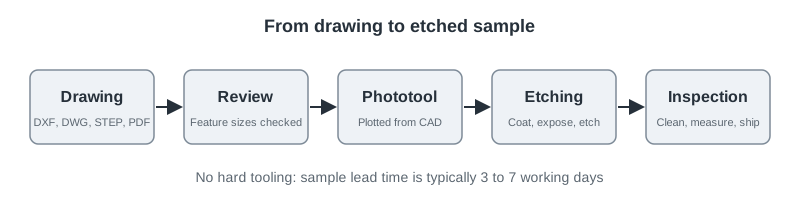
From drawing to sample
- Send the drawing with material, thickness and quantity.
- Manufacturability check. We review feature sizes against the thickness and suggest changes if needed.
- Phototool. The pattern is plotted from your CAD data.
- Etching. Sheets are coated, exposed, developed and etched.
- Inspection and dispatch. Parts are stripped, cleaned, inspected and shipped.
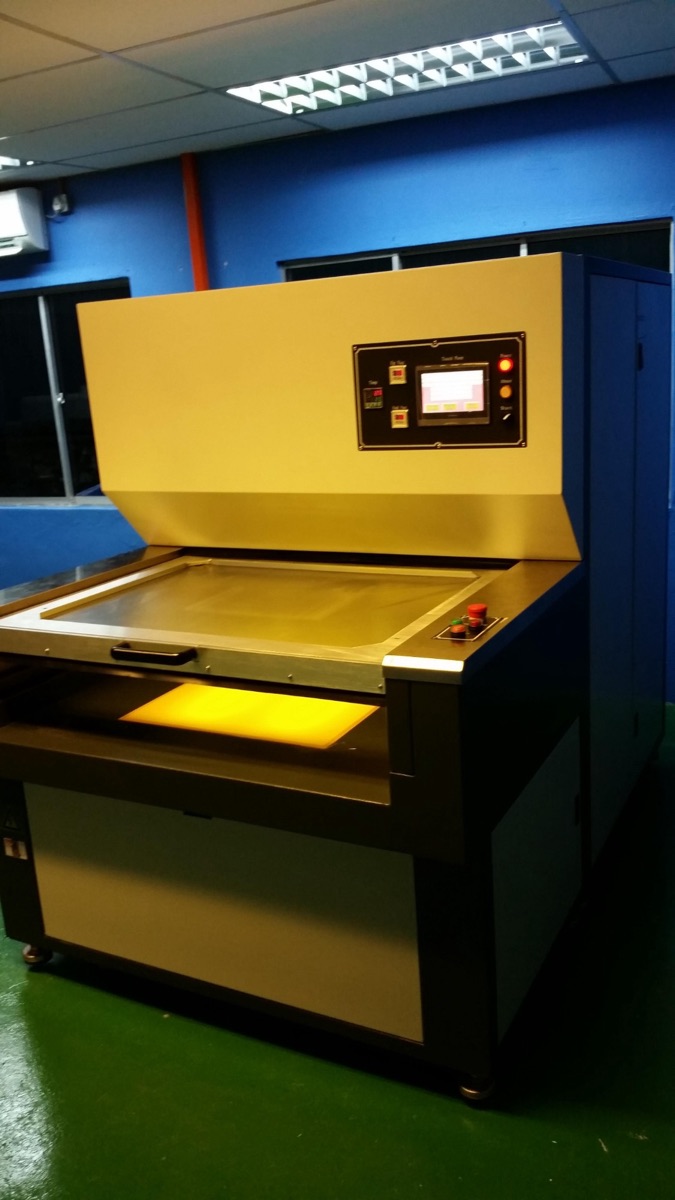
Prototype parts we commonly etch
Filter meshes and screens, shims and gaskets, spring contacts, EMI shielding cans, bipolar plates and flow field plates, encoder discs, speaker grilles, nameplates and decorative parts.
Materials
Stainless steel, copper, brass, phosphor bronze, nickel silver, aluminium, titanium, nickel and carbon steel, from 0.05 mm to 5.0 mm thick. See metals we etch.
Moving to production
Because no die is involved, the step from prototype to production is a larger order of the same part. If volumes later become very high and the design is fixed, stamping may become cheaper per part; see chemical etching vs stamping. Cost factors are explained in what chemical etching costs, and design rules in the chemical etching design guide.
Request a quote
Send your drawing in DXF, DWG, STEP or PDF format with the material and grade, thickness, quantity and required delivery date through our contact page. We check manufacturability against the drawing before tooling. Sample lead time is typically 3 to 7 working days. Drawings are treated as confidential.
Chemical etching prototype service: FAQ
How long does a chemical etching prototype take?
Sample lead time is typically 3 to 7 working days. Batch production timing depends on volume and current capacity.
Is there a minimum order quantity for prototypes?
Prototypes are made by the sheet, so even a small quantity is practical. Send the drawing and the quantity you need for a quotation.
Can several designs be prototyped at the same time?
Yes. Designs that use the same material and thickness can be nested on one sheet, which lowers the cost of testing variants.
Will production parts match the prototype?
Yes. Prototype and production parts are made by the same etching process, so material properties, edge condition and tolerances stay the same.
What do you need to make a prototype?
A drawing in DXF, DWG, STEP or PDF format, the material and grade, the thickness and the quantity.