
Etched car speaker grilles and acoustic mesh
A speaker grille has two jobs that pull against each other: let the sound out, and look like part of the interior. Photo etching is how you get both, because the hole pattern is drawn rather than tooled, so the acoustics and the styling are decided on the same drawing.
Why the hole pattern is the whole job
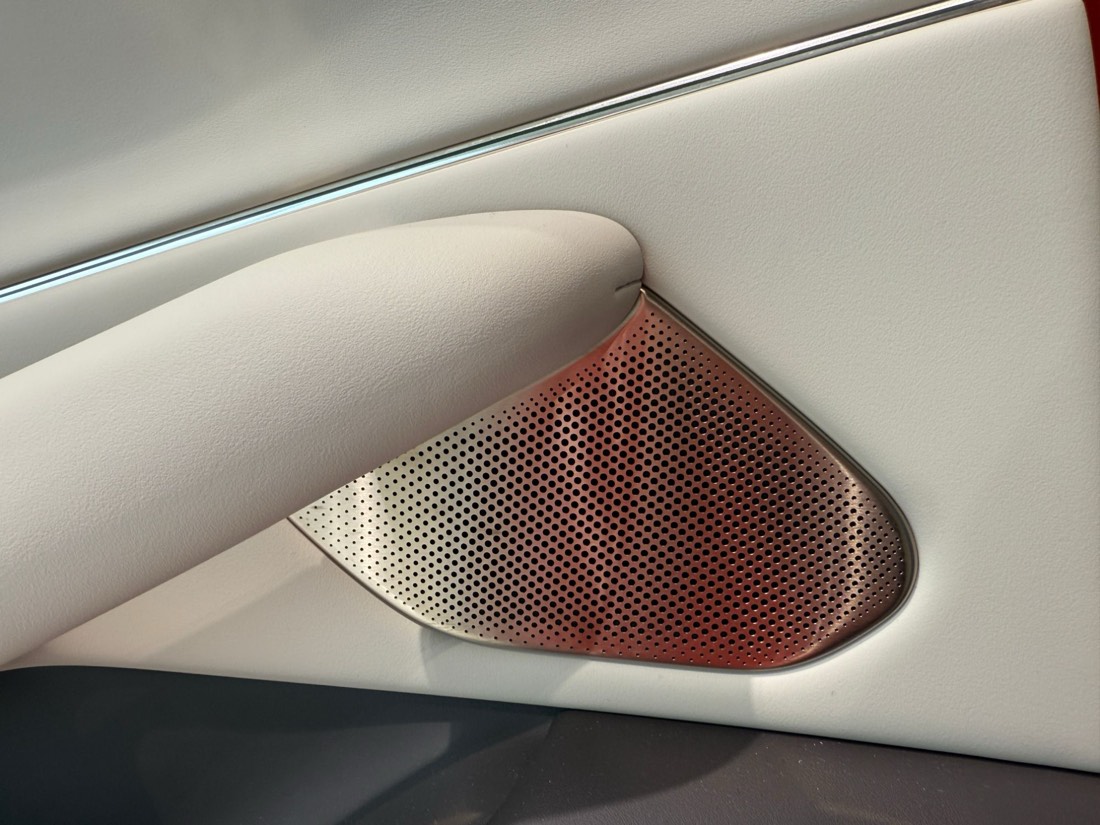
Look at the grille above. The holes are not one size. They are large in the middle and get progressively finer towards the edge, so the panel reads as a soft gradient rather than a punched sheet.
That is free in etching and expensive in anything else. Etching works from a phototool, so every hole on the sheet can be a different diameter at no extra cost, and changing the pattern between prototypes costs a new phototool rather than a new press tool. A punched grille needs a tool per hole size, which is why punched grilles tend to be one hole repeated.
The same applies to the outline. The grille profile, the mounting tabs and the holes are all cut in one operation, so a change to the trim shape does not cost a new blanking die.
Open area and what it costs you
Open area is the share of the panel that is hole rather than metal, and it is the number the acoustic engineer asks for first. Suppliers in this field commonly quote 35 to 50 per cent as the working range for a car grille. Treat that as a starting point, not a specification: we have not seen independent acoustic test data behind those figures, and the right number depends on the driver, the enclosure and how far the grille sits from the cone.
The physics is the part worth understanding:
- Too little open area raises acoustic resistance and takes the top end off the speaker. High frequencies suffer first.
- Too much open area leaves the panel flexible, and a grille that flexes can buzz at the frequencies you were trying to reproduce.
- Hole length matters as well as hole size. A thick panel turns every aperture into a short tube, which changes how it behaves acoustically.
Tell us the open area you need and the panel size, and we will come back with a hole diameter and pitch that hits it while keeping the pattern looking right. If you have the styling intent but no acoustic target, say so, and we will quote a pattern for your acoustic team to measure on a sample.
Burrs, and why they matter here
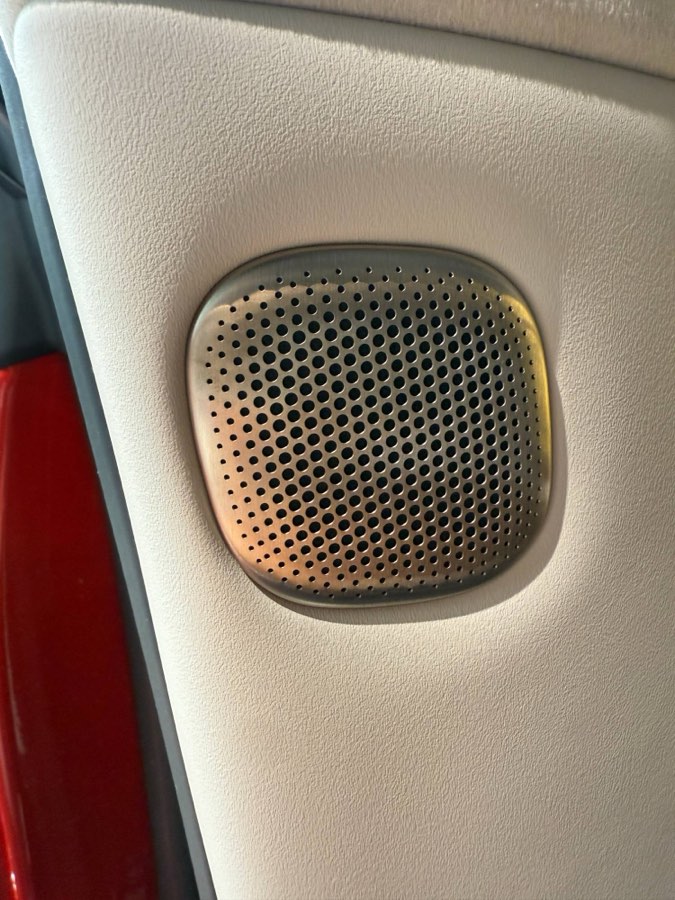
Punching and drilling leave a burr on the exit side of every hole. On a structural part nobody sees it. On a speaker grille it sits in the sound path, it catches the light at the edge of each aperture, and on a thin panel it becomes a deburring operation across thousands of holes.
Etching removes metal chemically from both faces, so there is no burr to remove and no mechanical stress around the apertures. That matters twice: the panel stays flat enough to form afterwards, and a thin grille does not arrive warped from the cutting operation.
Flat, formed and combined parts
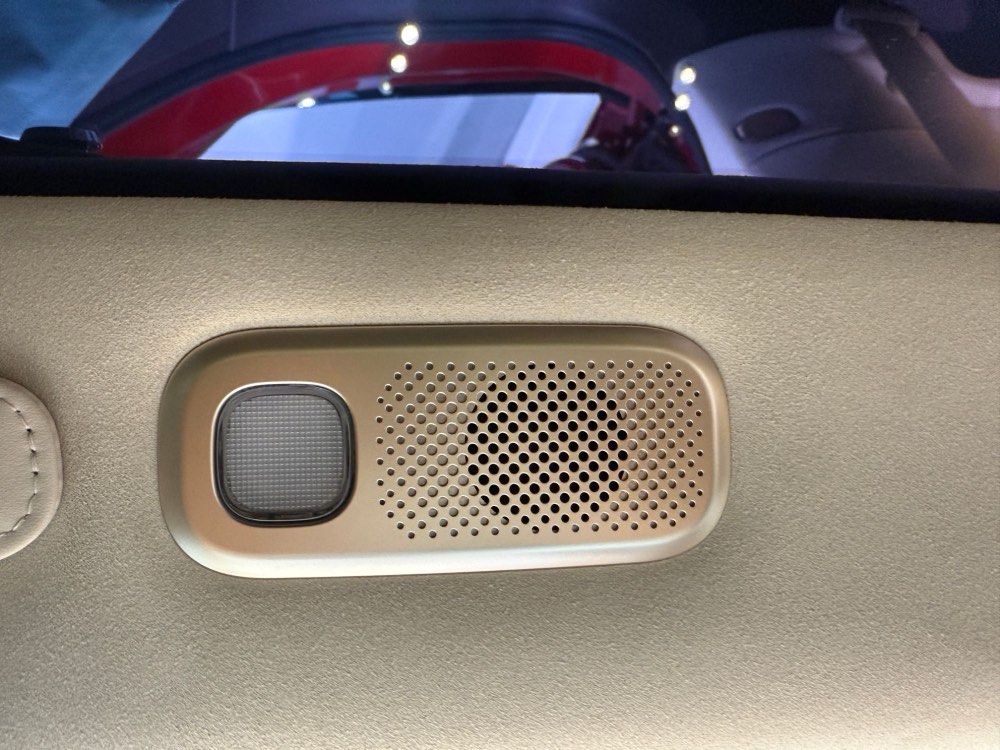
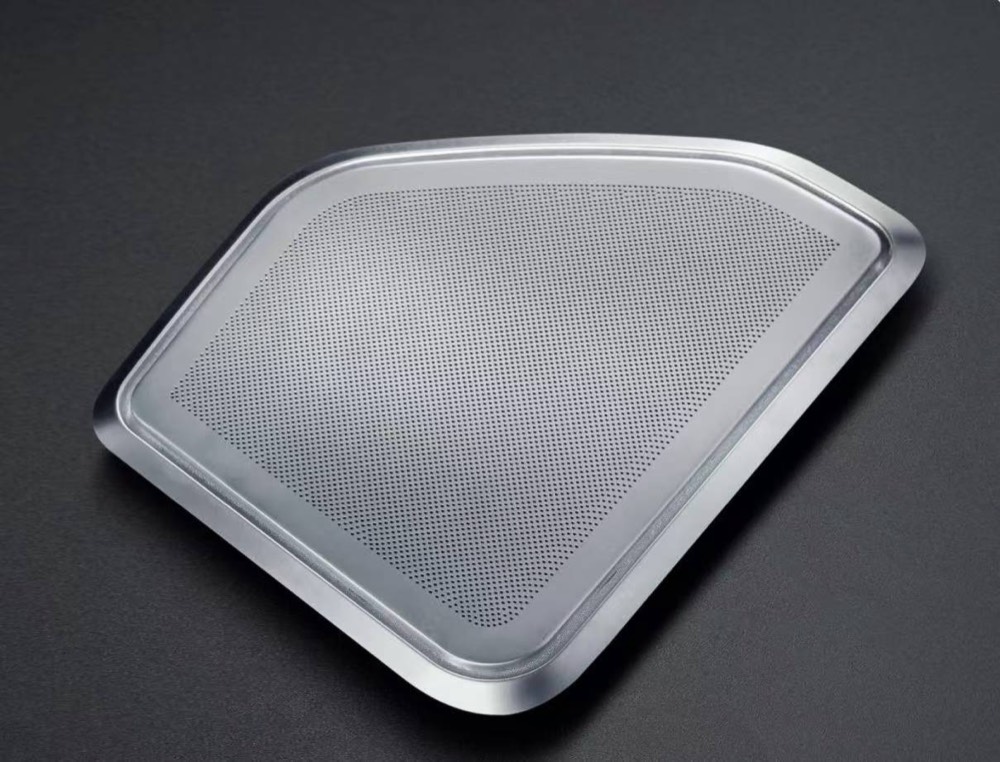
Most interior grilles are not flat. They are etched flat, then formed to the curve of the door card, the headliner or the pillar. We etch the blank with the holes, the outline and the fixing tabs in one pass, and the part is formed afterwards.
The panel above carries two different hole sizes on one piece of metal, each sized for what sits behind it. Two patterns on one part cost the same as one, because both are on the same phototool.
The pattern is a styling decision, not a cost one
Because the apertures come off a phototool, the shape of the hole is as free as its size. These are four production grilles, all made the same way, all priced the same way:
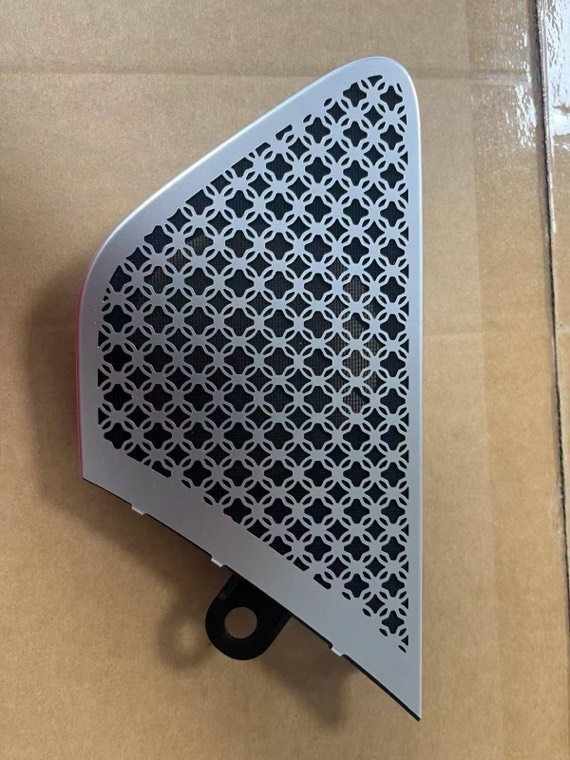
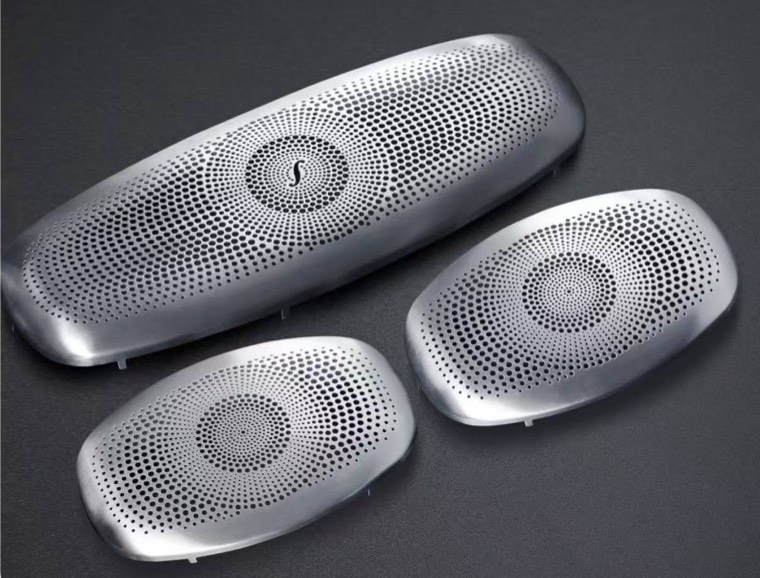
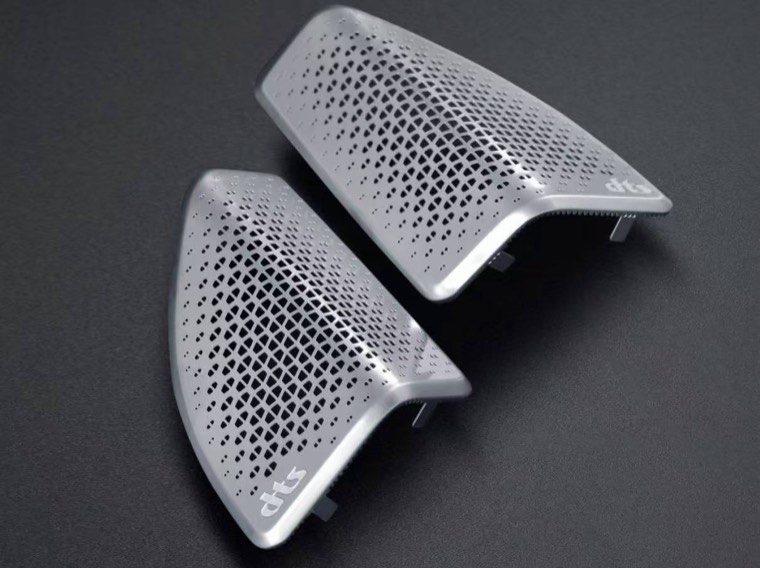
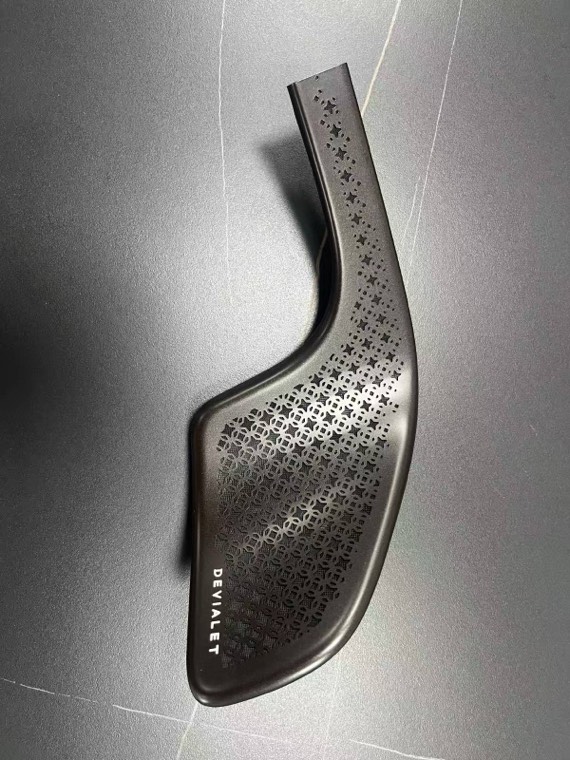
A punched grille has to repeat whatever shape the punch is. Here the hole can be round, oval, diamond, a four-leaf or a star, and it can change size across the panel, because none of it is tooled. If the interior designer has a motif, send it and we will tell you whether it will hold up at aperture size and what it does to the open area.
Materials and finish
| Material | Use it for |
|---|---|
| 304 stainless | The default for interior grilles, brushed or polished |
| 316 stainless | Convertibles and marine interiors, or where cleaning chemicals are harsh |
| 430 stainless | Where a magnetic grade is specified |
| Aluminium | Lighter panels, and where anodising gives the colour |
| Brass and copper | Warm tones for premium interiors |
Grille thickness usually runs 0.2 to 1.0 mm, within our overall 0.01 to 5 mm range, with etching accuracy of 0.01 mm. Brushed, polished and bead blast finishes are done in house; anodising and plating are outsourced to partners we have worked with for years.
Prototype to production
There is no hard tooling, so the first sample and the hundred thousandth part come off the same process. That changes how a grille programme runs: you can put three hole patterns in front of the acoustic team in one sample batch, measure them, and commit to the one that measures best, instead of committing to a punch tool and living with it.
Sample lead time is typically 3 to 7 working days once the pattern is agreed. A revised pattern needs a new phototool, not a new die.
Related
- Etched car door sill plates and scuff plates
- Etched stainless steel mesh for filtration and screening
- EMI and RF shielding for perforated shielding cans
- Chemical etching for the automotive industry
- Photo etching vs laser cutting
- Prototype etching service
Request a quote
Send the grille drawing as DXF, DWG, STEP or PDF with the panel size, the material and thickness, and the open area or hole pattern if it is already decided. Say whether the part is flat or formed, and send the form geometry if it is. If the pattern is still open, send the styling intent and the acoustic target and we will propose one. Sample lead time is typically 3 to 7 working days. Drawings are treated as confidential. Send them through our contact page.
Etched speaker grilles: FAQ
What open area should a car speaker grille have?
Suppliers in this field commonly work in the 35 to 50 per cent range, but that is a starting point rather than a standard. The right figure depends on the driver, the enclosure and the gap between grille and cone. Send us the acoustic target and we will propose a hole size and pitch, or quote a pattern for your team to measure.
Can the holes change size across one grille?
Yes, and it costs nothing extra. The pattern comes off a phototool, so every hole can be a different diameter. A graduated pattern that fades from coarse at the centre to fine at the edge is priced the same as a uniform pattern.
Do etched grilles have burrs?
No. Metal is dissolved from both faces rather than sheared, so there is no burr on the exit side and no deburring operation. That matters on a grille because the aperture edges are visible and sit in the sound path.
Can you supply formed grilles, not just flat blanks?
Yes. The blank is etched flat with holes, outline and fixing tabs in one operation, then formed. Send the form geometry with the drawing.
What thickness are speaker grilles?
Usually 0.2 to 1.0 mm for interior grilles. We etch from 0.01 to 5 mm overall, with 0.01 mm accuracy.